Free Abstract Doodle Art Portrait Pen and Ink Art

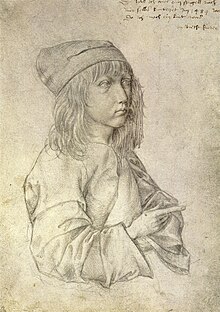
Drawing is a form of visual fine art in which an artist uses instruments to mark paper or other two-dimensional surface. Cartoon instruments include graphite pencils, pen and ink, various kinds of paints, inked brushes, colored pencils, crayons, charcoal, chalk, pastels, erasers, markers, styluses, and metals (such every bit silverpoint). Digital cartoon is the act of cartoon on graphics software in a computer. Common methods of digital drawing include a stylus or finger on a touchscreen device, stylus- or finger-to-touchpad, or in some cases, a mouse. There are many digital fine art programs and devices.
A drawing instrument releases a small amount of material onto a surface, leaving a visible marker. The most common support for drawing is paper, although other materials, such equally paper-thin, wood, plastic, leather, canvas, and board, have been used. Temporary drawings may be fabricated on a blackboard or whiteboard. Drawing has been a popular and fundamental ways of public expression throughout human history. Information technology is one of the simplest and most efficient means of communicating ideas.[1] The wide availability of drawing instruments makes drawing one of the nearly mutual artistic activities.
In addition to its more creative forms, drawing is oft used in commercial illustration, animation, compages, applied science, and technical drawing. A quick, freehand drawing, usually not intended as a finished work, is sometimes called a sketch. An creative person who practices or works in technical drawing may be called a drafter, draftsman, or draughtsman.[ii]
Overview [edit]

Drawing is i of the oldest forms of homo expression within the visual arts. It is mostly concerned with the marking of lines and areas of tone onto paper/other material, where the accurate representation of the visual world is expressed upon a plane surface.[3] Traditional drawings were monochrome, or at least had little colour,[4] while modern colored-pencil drawings may arroyo or cantankerous a boundary between drawing and painting. In Western terminology, drawing is distinct from painting, fifty-fifty though like media often are employed in both tasks. Dry media, normally associated with drawing, such as chalk, may be used in pastel paintings. Cartoon may be done with a liquid medium, applied with brushes or pens. Similar supports likewise can serve both: painting more often than not involves the application of liquid paint onto prepared canvas or panels, but sometimes an underdrawing is fatigued first on that same back up.
Drawing is oftentimes exploratory, with considerable emphasis on observation, trouble-solving and composition. Drawing is also regularly used in grooming for a painting, further obfuscating their distinction. Drawings created for these purposes are chosen studies.
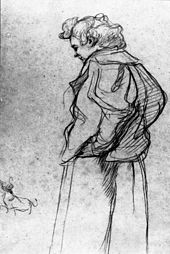
There are several categories of drawing, including figure drawing, cartooning, doodling, and freehand. There are also many drawing methods, such equally line drawing, stippling, shading, the surrealist method of entopic graphomania (in which dots are made at the sites of impurities in a blank sheet of paper, and lines are and so made between the dots), and tracing (drawing on a translucent newspaper, such every bit tracing newspaper, around the outline of preexisting shapes that show through the newspaper).
A quick, unrefined drawing may exist called a sketch.
In fields outside art, technical drawings or plans of buildings, mechanism, circuitry and other things are often called "drawings" fifty-fifty when they accept been transferred to some other medium by press.
History [edit]
In communication [edit]
Cartoon is one of the oldest forms of human expression, with prove for its existence preceding that of written advice.[5] It is believed that drawing was used every bit a specialised form of communication before the invention of the written linguistic communication,[five] [half-dozen] demonstrated by the product of cave and stone paintings around 30,000 years ago (Art of the Upper Paleolithic).[7] These drawings, known every bit pictograms, depicted objects and abstract concepts.[8] The sketches and paintings produced by Neolithic times were somewhen stylised and simplified in to symbol systems (proto-writing) and eventually into early on writing systems.
In manuscripts [edit]
Before the widespread availability of paper, twelfth-century monks in European monasteries used intricate drawings to fix illustrated, illuminated manuscripts on vellum and parchment. Drawing has also been used extensively in the field of science, as a method of discovery, understanding and caption.
In science [edit]
Cartoon diagrams of observations is an important part of scientific written report.
In 1609, astronomer Galileo Galilei explained the changing phases of Venus and too the sunspots through his observational telescopic drawings.[9] In 1924, geophysicist Alfred Wegener used illustrations to visually demonstrate the origin of the continents.[9]
As artistic expression [edit]
Drawing is used to express ane's inventiveness, and therefore has been prominent in the world of art. Throughout much of history, drawing was regarded as the foundation for artistic practice.[10] Initially, artists used and reused wooden tablets for the production of their drawings.[eleven] Post-obit the widespread availability of newspaper in the 14th century, the utilise of cartoon in the arts increased. At this point, drawing was unremarkably used every bit a tool for thought and investigation, acting equally a study medium whilst artists were preparing for their final pieces of work.[12] [xiii] The Renaissance brought virtually a peachy sophistication in cartoon techniques, enabling artists to represent things more than realistically than before,[fourteen] and revealing an interest in geometry and philosophy.[xv]
The invention of the start widely bachelor grade of photography led to a shift in the bureaucracy of the arts.[16] Photography offered an alternative to drawing every bit a method for accurately representing visual phenomena, and traditional drawing practice was given less emphasis every bit an essential skill for artists, specially so in Western society.[nine]
Notable artists and draftsmen [edit]
Drawing became significant as an art course around the tardily 15th century, with artists and principal engravers such every bit Albrecht Dürer and Martin Schongauer (c. 1448-1491), the starting time Northern engraver known by proper name. Schongauer came from Alsace, and was born into a family of goldsmiths. Albrecht Dürer, a principal of the adjacent generation, was as well the son of a goldsmith.[17] [18]
Onetime Chief Drawings frequently reflect the history of the country in which they were produced, and the fundamental characteristics of a nation at that time. In 17th-century Holland, a Protestant country, at that place were almost no religious artworks, and, with no King or court, almost art was bought privately. Drawings of landscapes or genre scenes were oft viewed not every bit sketches but as highly finished works of art. Italian drawings, however, show the influence of Catholicism and the Church, which played a major role in artistic patronage. The aforementioned is frequently truthful of French drawings, although in the 17th century the disciplines of French Classicism[19] meant drawings were less Baroque than the more than gratis Italian counterparts, which conveyed a greater sense of motility.[xx]
In the 20th century Modernism encouraged "imaginative originality"[21] and some artists' arroyo to drawing became less literal, more abstruse. Globe-renowned artists such as Pablo Picasso, Andy Warhol and Jean-Michel Basquiat helped challenge the status quo, with drawing existence very much at the center of their practice, and oft re-interpreting traditional technique.[22]
Basquiat'southward drawings were produced in many different mediums, virtually usually ink, pencil, felt-tip or mark, and oil-stick, and he drew on any surface that came to manus, such equally doors, wear, refrigerators, walls and baseball helmets.[23]
The centuries have produced a canon of notable artists and draftsmen, each with their own distinct language of drawing, including:
- 14th, 15th and 16th: Leonardo da Vinci[24] • Albrecht Dürer • Hans Holbein the Younger • Michelangelo • Pisanello • Raphael
- 17th: Claude • Jacques de Gheyn 2 • Guercino • Nicolas Poussin • Rembrandt • Peter Paul Rubens • Pieter Saenredam
- 18th: François Boucher • Jean-Honoré Fragonard • Giovanni Battista Tiepolo • Antoine Watteau
- 19th: Aubrey Beardsley • Paul Cézanne • Jacques-Louis David • Honoré Daumier • Edgar Degas • Théodore Géricault • Francisco Goya • Jean-Auguste-Dominique Ingres • Pierre-Paul Prud'hon • Odilon Redon • John Ruskin • Georges Seurat • Henri de Toulouse-Lautrec • Vincent van Gogh
- 20th: Max Beckmann • Jean Dubuffet • Thou. C. Escher • Arshile Gorky • George Grosz • Paul Klee • Oscar Kokoschka • Käthe Kollwitz • Alfred Kubin • André Masson • Alphonse Mucha • Jules Pascin • Pablo Picasso • Egon Schiele • Jean-Michel Basquiat • Andy Warhol
Materials [edit]
The medium is the ways by which ink, pigment or color are delivered onto the cartoon surface. Most drawing media are either dry (east.grand. graphite, charcoal, pastels, Conté, silverpoint), or use a fluid solvent or carrier (marker, pen and ink). Watercolor pencils can be used dry out like ordinary pencils, and then moistened with a wet brush to get various painterly effects. Very rarely, artists have fatigued with (usually decoded) invisible ink. Metalpoint cartoon usually employs either of ii metals: silver or lead.[25] More rarely used are gold, platinum, copper, contumely, bronze, and tinpoint.
Paper comes in a multifariousness of different sizes and qualities, ranging from newspaper grade upwards to high quality and relatively expensive paper sold equally private sheets.[26] Papers vary in texture, hue, acerbity, and strength when wet. Smooth paper is good for rendering fine detail, only a more than "toothy" paper holds the drawing material better. Thus a coarser material is useful for producing deeper contrast.
Newsprint and typing paper may be useful for practice and rough sketches. Tracing paper is used to experiment over a half-finished drawing, and to transfer a design from ane sheet to another. Cartridge paper is the basic blazon of cartoon paper sold in pads. Bristol board and even heavier acid-free boards, frequently with smooth finishes, are used for cartoon fine particular and do not distort when wet media (ink, washes) are applied. Vellum is extremely smooth and suitable for very fine detail. Coldpressed watercolor paper may be favored for ink cartoon due to its texture.
Acid-gratis, archival quality newspaper keeps its colour and texture far longer than wood pulp based paper such as newsprint, which turns yellow and becomes brittle much sooner.
The basic tools are a cartoon board or table, pencil sharpener and eraser, and for ink drawing, blotting paper. Other tools used are circle compass, ruler, and set square. Fixative is used to preclude pencil and crayon marks from smudging. Drafting tape is used to secure paper to drawing surface, and also to mask an area to go on it complimentary of accidental marks, such as sprayed or spattered materials and washes. An easel or slanted table is used to keep the drawing surface in a suitable position, which is generally more horizontal than the position used in painting.
Technique [edit]

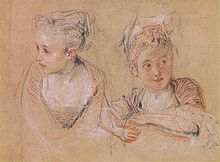
Well-nigh all draftsmen utilize their hands and fingers to apply the media, with the exception of some handicapped individuals who draw with their mouth or feet.[27]
Prior to working on an epitome, the artist typically explores how various media work. They may endeavor different drawing implements on do sheets to determine value and texture, and how to apply the implement to produce various effects.
The artist's choice of drawing strokes affects the appearance of the epitome. Pen and ink drawings oftentimes use hatching – groups of parallel lines.[28] Cross-hatching uses hatching in ii or more than different directions to create a darker tone. Broken hatching, or lines with intermittent breaks, class lighter tones – and controlling the density of the breaks achieves a gradation of tone. Stippling uses dots to produce tone, texture and shade. Dissimilar textures can be achieved depending on the method used to build tone.[29]
Drawings in dry media frequently utilize similar techniques, though pencils and drawing sticks can accomplish continuous variations in tone. Typically a drawing is filled in based on which paw the artist favors. A right-handed artist draws from left to right to avoid smearing the paradigm. Erasers can remove unwanted lines, lighten tones, and clean up stray marks. In a sketch or outline drawing, lines drawn ofttimes follow the contour of the subject area, creating depth by looking like shadows cast from a light in the creative person's position.
Sometimes the artist leaves a department of the epitome untouched while filling in the remainder. The shape of the area to preserve tin can be painted with masking fluid or cut out of a frisket and applied to the drawing surface, protecting the surface from stray marks until the mask is removed.
Another method to preserve a section of the image is to utilise a spray-on fixative to the surface. This holds loose material more firmly to the sheet and prevents it from smearing. However the fixative spray typically uses chemicals that tin impairment the respiratory organization, and so it should be employed in a well-ventilated area such as outdoors.
Some other technique is subtractive drawing in which the drawing surface is covered with graphite or charcoal and and then erased to brand the prototype.[30]
Tone [edit]

Shading is the technique of varying the tonal values on the paper to represent the shade of the cloth too as the placement of the shadows. Careful attending to reflected light, shadows and highlights tin result in a very realistic rendition of the epitome.
Blending uses an implement to soften or spread the original drawing strokes. Blending is nigh hands done with a medium that does not immediately fix itself, such as graphite, chalk, or charcoal, although freshly applied ink can exist smudged, wet or dry, for some furnishings. For shading and blending, the creative person can use a blending stump, tissue, a kneaded eraser, a fingertip, or any combination of them. A piece of chamois is useful for creating shine textures, and for removing cloth to lighten the tone. Continuous tone tin be achieved with graphite on a smooth surface without blending, but the technique is laborious, involving small circular or oval strokes with a somewhat blunt indicate.
Shading techniques that likewise innovate texture to the drawing include hatching and stippling. A number of other methods produce texture. In addition to the choice of newspaper, drawing material and technique affect texture. Texture can be made to appear more than realistic when it is drawn adjacent to a contrasting texture; a coarse texture is more obvious when placed next to a smoothly blended surface area. A similar effect can be achieved by cartoon different tones close together. A light edge next to a dark background stands out to the eye, and nearly appears to float above the surface.
Form and proportion [edit]

Proportions of the man body
Measuring the dimensions of a subject while blocking in the drawing is an of import step in producing a realistic rendition of the subject. Tools such as a compass can be used to mensurate the angles of different sides. These angles can exist reproduced on the cartoon surface and and so rechecked to brand sure they are accurate. Another form of measurement is to compare the relative sizes of different parts of the subject with each other. A finger placed at a point along the cartoon implement can be used to compare that dimension with other parts of the image. A ruler tin be used both every bit a straightedge and a device to compute proportions.
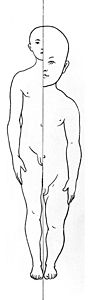
Variation of proportion with age
When attempting to draw a complicated shape such equally a human figure, information technology is helpful at first to represent the form with a ready of primitive volumes. Almost any form tin be represented by some combination of the cube, sphere, cylinder, and cone. Once these basic volumes accept been assembled into a likeness, then the drawing can be refined into a more accurate and polished course. The lines of the archaic volumes are removed and replaced by the final likeness. Drawing the underlying construction is a fundamental skill for representational art, and is taught in many books and schools. Its correct awarding resolves most uncertainties about smaller details, and makes the concluding epitome expect consequent.[31]
A more than refined art of figure drawing relies upon the artist possessing a deep understanding of anatomy and the human proportions. A trained artist is familiar with the skeleton construction, joint location, muscle placement, tendon movement, and how the different parts work together during motion. This allows the artist to return more natural poses that do non appear artificially stiff. The artist is also familiar with how the proportions vary depending on the age of the subject, particularly when drawing a portrait.
Perspective [edit]

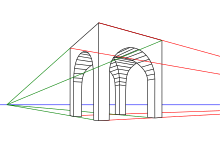
Linear perspective is a method of portraying objects on a flat surface so that the dimensions compress with altitude. Each gear up of parallel, straight edges of any object, whether a building or a tabular array, follows lines that eventually converge at a vanishing point. Typically this convergence point is somewhere along the horizon, as buildings are built level with the flat surface. When multiple structures are aligned with each other, such as buildings along a street, the horizontal tops and bottoms of the structures typically converge at a vanishing point.
When both the fronts and sides of a edifice are drawn, then the parallel lines forming a side converge at a second point along the horizon (which may exist off the drawing newspaper.) This is a two-signal perspective.[32] Converging the vertical lines to a tertiary point higher up or beneath the horizon and then produces a three-indicate perspective.
Depth can also be portrayed by several techniques in addition to the perspective arroyo above. Objects of like size should appear always smaller the farther they are from the viewer. Thus the back cycle of a cart appears slightly smaller than the front end wheel. Depth tin can be portrayed through the use of texture. As the texture of an object gets further away it becomes more than compressed and decorated, taking on an entirely dissimilar character than if it was close. Depth can besides be portrayed by reducing the contrast in more distant objects, and by making their colors less saturated. This reproduces the result of atmospheric haze, and cause the eye to focus primarily on objects fatigued in the foreground.

Artistry [edit]
The limerick of the epitome is an important element in producing an interesting piece of work of artistic merit. The artist plans element placement in the art to communicate ideas and feelings with the viewer. The composition tin can determine the focus of the art, and result in a harmonious whole that is aesthetically appealing and stimulating.
The illumination of the discipline is also a fundamental element in creating an artistic piece, and the coaction of low-cal and shadow is a valuable method in the artist's toolbox. The placement of the light sources tin make a considerable difference in the type of message that is being presented. Multiple low-cal sources can wash out any wrinkles in a person's face, for case, and give a more youthful appearance. In dissimilarity, a unmarried lite source, such as harsh daylight, tin serve to highlight whatsoever texture or interesting features.
When drawing an object or figure, the skilled creative person pays attention to both the area within the silhouette and what lies outside. The exterior is termed the negative infinite, and can be as important in the representation every bit the figure. Objects placed in the background of the figure should announced properly placed wherever they can be viewed.
A study is a draft drawing that is made in preparation for a planned terminal image. Studies can exist used to decide the appearances of specific parts of the completed image, or for experimenting with the best arroyo for accomplishing the end goal. Even so a well-crafted study can be a piece of fine art in its own right, and many hours of conscientious work can go into completing a report.
Process [edit]

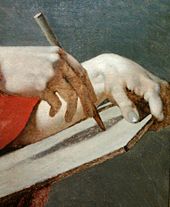
Individuals display differences in their ability to produce visually authentic drawings.[33] A visually accurate drawing is described equally being "recognized equally a item object at a particular fourth dimension and in a item space, rendered with little add-on of visual particular that tin can not be seen in the object represented or with little deletion of visual detail".[34]
Investigative studies have aimed to explain the reasons why some individuals describe ameliorate than others. I study posited four central abilities in the cartoon process: motor skills required for marker-making, the drawer'south own perception of their drawing, perception of objects being drawn, and the ability to make good representational decisions.[34] Following this hypothesis, several studies have sought to conclude which of these processes are nearly significant in affecting the accuracy of drawings.
- Motor control
Motor command is an important physical component in the 'Production Phase' of the drawing process.[35] It has been suggested that motor control plays a role in drawing power, though its effects are not significant.[34]
- Perception
It has been suggested that an individual's ability to perceive an object they are drawing is the most of import stage in the drawing process.[34] This suggestion is supported by the discovery of a robust human relationship between perception and drawing ability.[36]
This prove acted every bit the basis of Betty Edwards' how-to-draw volume, Cartoon on the Correct Side of the Brain.[37] Edwards aimed to teach her readers how to depict, based on the development of the reader's perceptual abilities.
Furthermore, the influential artist and art critic John Ruskin emphasised the importance of perception in the drawing procedure in his book The Elements of Drawing.[38] He stated that "For I am near convinced, that once nosotros see keenly plenty, there is very little hard in drawing what we run across".
- Visual retentivity
This has also been shown to influence one's ability to create visually accurate drawings. Short-term memory plays an important part in drawing as 1's gaze shifts betwixt the object they are drawing and the drawing itself.[39]
- Decision-making
Some studies comparing artists to non-artists have found that artists spend more time thinking strategically while cartoon. In detail, artists spend more time on 'metacognitive' activities such as considering different hypothetical plans for how they might progress with a drawing.[40]
Run across also [edit]
- University figure
- Architectural drawing
- Composition
- Profile drawing
- Diagram
- Digital illustration
- Applied science drawing
- Figure cartoon
- Graphic blueprint
- Illustration
- Landscape painting
- Painting
- Plumbago drawing
- Sketch (drawing)
- Subtractive drawing
- Technical drawing
- Visual arts
- Epitome
References [edit]
Notes
- ^ www.sbctc.edu (adapted). "Module half-dozen: Media for 2-D Art" (PDF). Saylor.org. Retrieved ii April 2012.
- ^ "the definition of draftsman". Retrieved 1 January 2017.
- ^ "Archived copy" (PDF). Archived from the original (PDF) on 2016-03-03. Retrieved 2014-03-eleven .
{{cite web}}: CS1 maint: archived copy as title (link) - ^ See grisaille and chiaroscuro
- ^ a b Tversky, B (2011). "Visualizing thought". Topics in Cerebral Science. 3 (3): 499–535. doi:10.1111/j.1756-8765.2010.01113.x. PMID 25164401.
- ^ Farthing, S (2011). "The Bigger Picture of Cartoon" (PDF). Archived from the original (PDF) on 2014-03-17. Retrieved 2014-03-11 .
- ^ Thinking Through Drawing: Do into Knowledge Archived 2014-03-17 at the Wayback Machine 2011c[ page needed ]
- ^ Robinson, A (2009). Writing and script: a very short introduction. New York: Oxford University Press.
- ^ a b c Kovats, T (2005). The Drawing Book. London: Black Dog Publishing.
- ^ Walker, J. F; Duff, 50; Davies, J (2005). "Old Manuals and New Pencils". Drawing- The Process. Bristol: Intellect Books.
- ^ See the give-and-take on erasable drawing boards and 'tafeletten' in van de Wetering, Ernst. Rembrandt: The Painter at Work.
- ^ Burton, J. "Preface" (PDF). Archived from the original (PDF) on 2014-03-17. Retrieved 2014-03-11 .
- ^ Chamberlain, R (2013). Cartoon Conclusions: An exploration of the cognitive and neuroscientific foundations of representational cartoon (Doctoral).
- ^ Davis, P; Duff, 50; Davies, J (2005). "Drawing a Bare". Drawing – The Procedure . Bristol: Intellect Books. pp. 15–25. ISBN9781841500768.
- ^ Simmons, S (2011). "Philosophical Dimension of Drawing Instruction" (PDF). Archived from the original (PDF) on 2014-03-17. Retrieved 2014-03-11 .
- ^ Poe, E. A. (1840). The Daguerreotype. Classic Essays on Photography. New Haven, CN: Leete's Isle Books. pp. 37–38.
- ^ "Old Master prints and engravings | Christie'south". Retrieved 2018-04-xx .
- ^ Hinrich Sieveking, "German Draughtsmanship in the Ages of Dürer and Goethe", British Museum. Accessed 20 February 2016
- ^ Barbara Hryszko, A Painter as a Draughtsman. Typology and Terminology of Drawings in Bookish Teaching and Creative Practise in French republic in 17th Century [dans:] Metodologia, metoda i terminologia grafiki i rysunku. Teoria i praktyka, ed. Jolanta Talbierska, Warszawa 2014, pp. 169-176.
- ^ "Onetime Primary drawings | Christie's". Retrieved 2018-04-20 .
- ^ Duff, L; Davies, J (2005). Drawing – The Process. Bristol: Intellect Books.
- ^ Gompertz, Will (2009-02-12). "My life in art: How Jean-Michel Basquiat taught me to forget about technique". the Guardian . Retrieved 2018-04-20 .
- ^ "nail for real: a dictionary of basquiat". I-d. 2017-09-26. Retrieved 2018-04-20 .
- ^ ArtCyclopedia, February 2003, "Masterful Leonardo and Graphic Dürer". Accessed xx February 2016
- ^ lara Broecke, Cennino Cennini's Il Libro dell'Arte: a new English Translation and Commentary with Italian Transcription, Archetype 2015
- ^ Mayer, Ralph (1991). The Artist'due south Handbook of Materials and Techniques . Viking. ISBN978-0-670-83701-4.
- ^ "The Amazing Art of Disabled Artists". Webdesigner Depot. 16 March 2010. Retrieved 1 Jan 2017.
- ^ This is unrelated to the hatching system in heraldry that indicates tincture (i.due east., the color of artillery depicted in monochrome.)
- ^ Guptill, Arthur L. (1930). Drawing with Pen and Ink. New York: Reinhold Publishing Corporation.
- ^ S, Helen, The Everything Drawing Volume, Adams Media, Avon, MA, 2004, pp. 152–53, ISBN one-59337-213-2
- ^ Unhurt, Robert Beverly (1964). Drawing Lessons from the Nifty Masters (45th Ceremony ed.). Watson-Guptill Publications (published 2009). ISBN978-0-8230-1401-9.
- ^ Watson, Ernest W. (1978). Form in Pencil Sketching: Iv Books in Ane. New York: Van Nostrand Reinhold Company. pp. 167–75. ISBN978-0-442-29229-4.
- ^ Ostrofsky, J (2011). "A Multi-Stage Attending Hypothesis of Drawing Ability" (PDF). Archived from the original (PDF) on 2014-03-17. Retrieved 2014-03-11 .
- ^ a b c d Cohen, D. J; Bennett, S. (1997). "Why can't nigh people draw what they see?". Journal of Experimental Psychology. 67 (6): 609–21. doi:10.1037/0096-1523.23.3.609.
- ^ van Somers, P (1989). "A system for cartoon and drawing-related neuropsychology". Cognitive Neuropsychology. half-dozen (2): 117–64. doi:10.1080/02643298908253416.
- ^ Cohen, D. J.; Jones, H. Due east. (2008). "How shape constanct related to drawing accuracy" (PDF). Psychology of Aesthetics, Creativity, and the Arts. ii (1): 8–xix. doi:10.1037/1931-3896.2.1.8.
- ^ Edwards, B (1989). Drawing on the Correct Side of the Encephalon. New York: Putnam. ISBN978-one-58542-920-2.
- ^ Ruskin, John (1857). The Elements of Drawing. Mineola, NY: Dover Publishcations Inc.
- ^ McManus, I. C.; Chamberlain, R. S.; Loo, P.-K.; Rankin, Q.; Riley, H.; Brunswick, N. (2010). "Art students who cannot describe: exploring the relations between drawing ability, visual memory, accurateness of copying, and dyslexia" (PDF). Psychology of Aesthetics, Creativity, and the Arts. iv: xviii–30. CiteSeerXx.1.1.654.5263. doi:10.1037/a0017335. Archived from the original (PDF) on 2017-10-26. Retrieved 2017-10-25 .
- ^ Fayena-Tawil, F.; Kozbelt, A.; Sitaras, S. (2011). "Think global, act local: A protocol analysis comparison of artists' and nonartists' cognitions, metacognitions, and evaluations while drawing". Psychology of Aesthetics, Inventiveness, and the Arts. 5 (2): 135–45. doi:10.1037/a0021019.
Further reading
- Edwards, Betty. The New Drawing on the Correct Side of the Brain, HarperCollins Publishers Ltd; 3Rev Ed edition, 2001, ISBN 978-0-00-711645-4
- Brommer, Gerald F. Exploring Drawing. Worcester, Massachusetts: Davis Publications. 1988.
- Bodley Gallery, New York, Modern master drawings, 1971, OCLC 37498294.
- Holcomb, M. (2009). Pen and Parchment : Drawing in the Middle Ages . New York: The Metropolitan Museum of Art.
- Hillberry, J.D. Drawing Realistic Textures in Pencil, Northward Calorie-free Books, 1999, ISBN 0-89134-868-9.
- Landa, Robin. Take a line for a walk: A Creativity Journal. Boston: Wadsworth, 2011. ISBN 978-1-111-83922-2
- Lohan, Frank. Pen & Ink Techniques, Contemporary Books, 1978, ISBN 0-8092-7438-eight.
- Ruskin, J. (1857). The Elements of Drawing. Mineola, NY: Dover Publications Inc. ISBN 978-1-4538-4264-5
- Spears, Heather. The Creative Eye. London: Arcturus. 2007. ISBN 978-0-572-03315-six.
- World Volume, Inc. The Earth Book Encyclopedia Volume 5, 1988, ISBN 0-7166-0089-7.
- Drawing/Thinking: Confronting an Electronic Age, edited past Marc Treib, 2008, ISBN 0-415-77560-4
External links [edit]
 | Wikimedia Commons has media related to Drawing. |
 | Look up drawing in Wiktionary, the costless dictionary. |
 | Wikiversity has learning resources about Drawing |
- Timeline of Drawing Evolution in Children
- On Cartoon, an essay well-nigh the craft of cartoon, by artist Norman Nason. Archived from the original on April 25, 2012.
- Line and Form (1900) by Walter Crane at Project Gutenberg
- Leonardo da Vinci: anatomical drawings from the Royal Library, Windsor Castle, exhibition itemize fully online equally PDF from The Metropolitan Museum of Art (a slap-up cartoon resource).
- Leonardo da Vinci, Principal Draftsman, exhibition itemize fully online equally PDF from The Metropolitan Museum of Art (a peachy drawing resources).
- Drawing in the Middle Ages A summary of how drawing was used as office of the artistic procedure in the Middle Ages.
Source: https://en.wikipedia.org/wiki/Drawing

Post a Comment for "Free Abstract Doodle Art Portrait Pen and Ink Art"