Flour Clip Art Putting Flour on a Guinea Pig

The other dark, as I went through my inbox deleting the junk mail that had accumulated throughout the solar day, a subject field line caught my eye: "Dreaming in moments of uncertainty." The email was from Women for Political Change (WFPC), one of the many Minnesota organizations that provided support to protestors in Minneapolis following George Floyd's murder. I fabricated a pocket-sized donation to back up their essential piece of work in those dark days, and have received their occasional emails ever since. WFPC has spearheaded a number of programs in the Twin Cities area, all geared toward supporting "the leadership and political power of young women and trans & non-binary folks." One of their cardinal projects has been to create common assist networks, as defined in this wonderful graphic on their website:

When I saw that their latest electronic mail had the subject line "Dreaming in moments of uncertainty," I opened information technology immediately. Here is an excerpt from their message: "Our collective power is undeniable when nosotros agitate for transformational change, grow through healing justice principles, and dream of alternative vision together. Regardless of what course this shift might take, we can rely on our hopes, dreams, and the agency to build political power…. In thinking of Mariame Kaba's grounding statement, that hope is a discipline, what does dreaming in moments of uncertainty, like today, wait like to you?"
Reading this, I was reminded of a column I wrote for my college newspaper back in 2016, in the run-upward to the November ballot. The political climate was tense—little did I await it to go so much worse with the unimaginable (at the time) election of Donald Trump—and I had begun to wonder whether room for promise remained. So I wrote an essay titled "Don't Be Afraid to Dream," about the power of hope and the imperative of dreaming up a better future. Seeing these ideas reflected in the recent email from Women for Political Modify—an organization that has been at the forefront of tangible action—reassured me that the conclusion I came to 4 years ago remains truthful today: "To exist optimistic is to admit that though things aren't perfect, they can be improved with dedication and difficult piece of work. It may be a long slog—as change often is—but to recognize that at that place is potential for a improve time to come is the first step toward making that dream a reality. […] The moment we lose even the faintest glimmer of promise—the moment nosotros descend into cynicism and despair—nosotros lose all power to shape the time to come."
I was grateful for this reminder, given the tumultuous times in which we notice ourselves. In case any Two in the World readers are in need of the same reminder, I am including my 2016 essay below.
***
DON'T Be Afraid TO DREAM (2016)
The hereafter belongs to those who believe in the beauty of their dreams.
For the by couple of years, I've been enamored with Eleanor Roosevelt's famous quote. Reassured and inspired past her conviction that the dreams of today can shape the future of tomorrow, I wrote it on my whiteboard the moment I moved into my dorm room so that I could see information technology every twenty-four hour period.
But lately, I've begun to wonder if this quote expresses naïve idealism and callow faith in our ability to achieve our dreams. Eight years ago, Barack Obama inspired u.s.a. with his phone call for hope. Could such a call band true today? Is there a place for optimism in our current political climate? I say there is.
In 2000, world-renowned cellist Yo-Yo Ma invited a group of musicians to join him for a weekend retreat. They came from all over the world with their violins, a clarinet or 2, bagpipes, a traditional Iranian kamancheh, a Chinese pipa. Ma'southward thought was to "explore how the arts can advance global understanding."
Within a twelvemonth, several of the musicians founded the Silk Road Ensemble. 16 years later, they are still touring the globe, performing compositions that weave together musical traditions spanning fourth dimension and infinite. Their mission, as stated on their website, is to "connect the world through the arts."
I'yard then glad I saw the film The Music of Strangers, a documentary about the Ensemble, directed and produced by filmmaker Morgan Neville, that was released this summer. The film is explicitly well-nigh the ability of music. And although some of the musicians raise doubts about the extent of that ability—suggesting that information technology is is dwarfed in lite of the struggles many of them have faced, in lite of violence and hatred and war—it'due south impossible to achieve the end credits without feeling a renewed sense of hope, without thinking that this group of musicians is making the earth a meliorate identify.
Simply hope is a tricky thing, as nosotros're witnessing in our current election bicycle. "It could be," David Brooks wrote in the New York Times in July, "that in this moment of fear, pessimism, feet and farthermost cynicism, many voters may accept decided that civility is a give up to a rigged system, that optimism is the opiate of the idiots."
Merely optimism and naïveté are not the aforementioned. Promise isn't just "the opiate of the idiots"; it tin even go hand in manus with disillusionment. For to be optimistic is to acknowledge that though things aren't perfect, they can be improved with dedication and difficult work. It may be a long slog—every bit change often is—but to recognize that there is potential for a improve future is the first step toward making that dream a reality.
There volition, of course, be times of hopelessness. But the moment we lose even the faintest glimmer of hope—the moment nosotros descend into cynicism and despair—we lose all power to shape the future. As Brooks concludes, if voters really have decided that "optimism is the opiate of the idiots … so the throes of a completely new birth are upon united states of america and Trump is a homo from the hereafter." Indeed, Trump's chief talent is exploiting hopelessness to convince u.s.a. that he "solitary can set up it."
Possibly that's the ability of the arts: Whether it be music, painting or literature, art offers some semblance of hope, even in the about bleak circumstances.
At the end of The Music of Strangers, one of the members of the Silk Road Ensemble, a Syrian clarinetist, visits a refugee military camp, smuggling in dozens of recorders for the children. The audience around me gasped at an overhead shot of the dusty tent-metropolis that stretched from horizon to horizon, where men, women, and children are somehow expected to brand a home and live a normal life. But the recorders are a gift of music, a small token of hope.
The Music of Strangers may be virtually the power of the arts, simply at middle, information technology's about maintaining promise. Information technology's near taking optimism from the realm of the passive into that of the active. For hope must be a spark that spurs us to action. The Silk Road Ensemble is i incarnation of optimism, but at that place are countless others, some already out at that place, others waiting to be built-in.
What exactly did Eleanor Roosevelt mean when she said, "The time to come belongs to those who believe in the beauty of their dreams"? She was, I think, urging usa not to lose faith in the ability of hope and our ability to achieve a better hereafter.
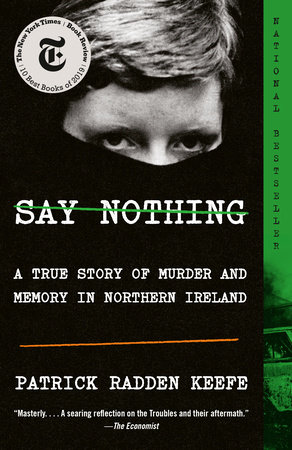
I recently finished Patrick Radden Keefe'due south laurels-winning book Say Nothing: A True Story of Murder and Memory in Northern Republic of ireland (Doubleday, 2018). It is a fascinating study of the Troubles and their backwash. But the questions Keefe raises transcend Northern Republic of ireland: Why is it important to reckon with the violence of the past? What office does commonage memory play in a healthy democracy? How do we pause historical silences?
Regarding the 1998 Adept Friday Agreement—which brought an end to 30 years of violence betwixt Irish (Catholic) republicans, (Protestant) loyalists, and the British military—Keefe writes: "In their effort to bring about peace, the negotiators had focused on the time to come rather than the past. […] [T]here was no provision for the creation of any sort of truth-and-reconciliation mechanism that might permit the people of Northern Ireland to address the sometimes murky and often painful history of what had befallen their country over the previous three decades. […] Northern Ireland had always been devoted to the theater of historical commemoration. But there was no formal process for attempting to figure out how to commemorate, or even to understand, the Troubles" (Chapter twenty: A Secret Archive).
I am struck past the extent to which this passage applies to the U.s.' relationship with our history of slavery. White Americans have long participated in "the theater of historical commemoration"—think Colonial Williamsburg and Civil War reenactments—just our national reckoning with slavery and its 150 year legacy has been piecemeal. Every bit such, past traumas continue to haunt the present.
Things may have turned out differently had Abraham Lincoln lived to see the U.S. through Reconstruction—as I've been reminded over the past couple weeks, while pedagogy 19th century history to immigrants here in Los Angeles who have applied to go naturalized U.Due south. citizens. My mom and I still vividly remember reading the following passages in Joy Hakim'due south "A History of US" during an 8th class history lesson: "Reconstruction didn't plow out the way Lincoln intended. He wanted the nation'south wounds leap carefully. He wanted healing to take place. He wanted North and South to exist one united nation. He wanted those who had been slaves to exist treated like total citizens" (War, Terrible War, p.148). Instead, thanks to John Wilkes Berth, we ended up with Andrew Johnson: "He didn't listen. He didn't try to represent the whole country. He didn't know how to compromise. He seemed to stand up against well-nigh Northerners, all blacks, and the moderate Southern Unionists. He went on a speaking tour and said wild and nasty things about Congress. Often, he didn't deed dignified or presidential. Some people were ashamed of their president. […] He was convinced that it was not the responsibleness of the nation to help the newly freed men and women get fair and equal treatment earlier the constabulary. He thought that was the states' job" (Reconstructing America, pp.30–31).
So, Reconstruction did non provide the opportunity for commonage reckoning so desperately needed subsequently 250 years of slavery. What would such a process look like in the U.S. today?
In the 4th episode of her new podcast, "The Concluding Archive," Harvard historian Jill Lepore analyzes three projects that take, over the past century, aimed to counter the silencing of Black voices: Oral histories with the terminal surviving Americans born into slavery, conducted past the WPA between 1936 and 1938; Invisible Man, Ralph Ellison's 1952 novel "made up of blackness voices"; and Isabel Wilkerson's Pulitzer Prize-winning book, The Warmth of Other Suns (2010), based upon hundreds of interviews with aging participants in the Great Migration. Ida Mae Brandon was one of the octogenarians Wilkerson interviewed; at one indicate, Brandon says—of the history she lived—"The half ain't been told." Running with this theme, Lepore concludes that "Ralph Ellison and the WPA opened a door, a door to an entire annal. Simply somehow that door keeps slamming shut, and getting locked again. And all the same, people go on trying to pry it open, and tape the evidence. In 2013…George Zimmerman was acquitted for the shooting expiry of Trayvon Martin, and Black Lives Matter began. […] Black Lives Thing is about justice; but it's too, profoundly, most testify: the capturing of video and sound, the recording of what—to whites—had been unseen, hearing what had been unheard, knowing what had been unknown. […] Some truths still can't be spoken, some frequencies haven't yet been heard. Just you tin can still set them down for the tape. You lot listen, you record, and you lot write. Considering the half still hasn't even so been told."
Too many voices have been silenced throughout U.S. history. We must continue breaking these silences. That means an end to romanticizing, white-washing, sanitizing, and erasing the ugliness of our past. For white Americans, it means listening. Black Lives Affair is the latest affiliate in an ongoing struggle to reckon with this country's traumatic history.
I volition conclude with the following excerpt from a Seamus Heaney poem, quoted in Say Nothing:
History says, Don't hope
On this side of the grave
But and then, once in a lifetime
The longed-for tidal moving ridge
Of justice can rise up
And promise and history rhyme.
Seamus Heaney
Hither in the U.S., as in Northern Ireland, hope and history tin can rhyme only when we permit silencing to continue no longer. Merely when we take faced our demons tin we forge a better time to come.

I take finally figured out my sourdough baking regimen. Dare I say, perfected it? I call back not (annotation the title of this mail service), but I am happy enough with my routine that I'd similar to share it with any aspiring sourdough bakers seeking inspiration, encouragement, or reassurance.
As I explained in Part 1 of this postal service, my household acquired a new member at the outset of the pandemic: Stan the sourdough starter. Stan's advent in our lives was prompted past the concern that we would non be able to obtain breadstuff while in COVID-nineteen lockdown; nosotros take bread very seriously in our house. So nosotros ordered a dehydrated sourdough starter from Cultures for Wellness. After a calendar week of daily feedings (flour and h2o) the starter was activated and prepare to be used. (As an alternative to ordering a dehydrated starter, you tin can adopt some of a friend's or brainstorm a starter from scratch.)
A Couple Notes
Before we go whatever further, I must brand two important points regarding (1) sourdough "discard" and (2) kitchen tools.
(1) DISCARD: Every fourth dimension y'all feed your starter, it grows exponentially. Not only are yous calculation flour and water; one time fed, the starter produces gas leading it to double in volume. And then, the only way to keep your starter a manageable size is to "discard" some of it before each feeding. There are a few ways to "discard": yous tin compost the backlog starter, put information technology in the garbage, or (my favorite!) use it in broiled goods. More than on this later.
(2) TOOLS: I am an old-fashioned baker. Mostly speaking, I'one thousand happy with the simplest of kitchen tools: bowl, spoon, pocketknife, measuring spoons and cups, etc. However, when it comes to sourdough baking, there are two gadgets I could non practise without: a food scale and instant-read thermometer. These are affordable ($30 total) essentials you volition come to love!
PREP
Once Stan the starter was active—happily bubbling within a few hours of feedings—I put 60 grams in a small glass container and tucked information technology abroad in the fridge. One evening (DAY ane), after about a week, I pull him out, transfer him into a larger jar, and feed him. The feeding formula is: equal quantities by weight starter, flour, water. I keep 60g starter, so that means stirring in 60g flour and 60g water. Stan then spends the night on the counter.
-
60g starter kept in the fridge for ~7 days -
Starter freshly fed 60g flour & 60g water


In the morning (DAY 2), I divide Stan three means (this is when the food scale is so helpful!). I remove 38g to go a levain going (meet below); this somewhen will join a mixture of flour, h2o, and salt to go 2 delicious loaves of staff of life. Of the remaining starter, 60g goes back in the fridge for the following week. This leaves me with nigh 80g "discard," which I feed (equal parts water and flour) then I tin use it later on to make a batch of scones. What I dear then much about this routine is that I don't waste any starter!

38g starter for bread, fed according to levain recipe below;
80g "discard" for scones, fed 80g flour & 80g water.
RECIPES: Bread & Scones
BREAD: I use Maurizio Leo'due south Beginner'southward Sourdough Bread, from his website The Perfect Loaf. (Aye, I know information technology'due south ironic I source my recipe from a website called "The Perfect Loaf" given that—equally explained in Role one of this mail service—I'm using sourdough baking to encompass imperfection. But what would life be without irony?) The recipe below is Maurizio'due south, paraphrased and very lightly edited; all I have done is simplify it for readers who, like myself, prefer to go on things curt and sweet in the kitchen.
Make your levain: Mix together in a jar 37g sourdough starter, 37g whole wheat flour, 37g bread flour, 74g h2o. Store somewhere warm for v–6 hours. The levain is the agent responsible for making your bread dough rise.
4 hours after: With your easily, mix together in a large bowl 748g breadstuff flour, 159g whole wheat flour, 641g warm water. Comprehend the basin and store next to your levain for 1 hour.

NOTE: Sourdough is MESSY. Flour and water congeal into a glue-like substance that is truly a pain to make clean upwardly. I discover it helpful to continue a basin of cold water at the ready. Yes, cold h2o; warm h2o causes gluten to develop and just makes things stickier. After the above mixing step, your hands volition be covered in dough. Rinse them off in the basin. Also toss all utensils into the cold h2o so the dough residue doesn't dry out (making clean-up all the more than impossible).
ane hour later: Add to the flour and water mixture levain, 18g body of water salt, ~50g warm water. Just add enough water to mix everything together with your easily.
Majority fermentation for 4 hours: Perform 3 sets of stretch and folds during bulk fermentation, spaced out by xxx mins. "Wet your hands with a little water to prevent sticking and so lift upwardly one side (Due north) of the dough with ii hands. Stretch the dough upwards loftier enough just and so that y'all can fold it completely over to the other side of the dough in the bowl. Rotate the bowl 180° and do the other side (South). Terminate the other two sides (East and West) to complete the gear up. Let the dough rest 30 minutes, covered, between sets. Afterward that third set of stretch and folds, let the dough residuum for the remainder of bulk fermentation."
SCONES: At this indicate, while the dough is fermenting, it'due south time to broil scones! I follow this recipe from Bake from Scratch. (The ane cup sourdough starter called for is exactly how much you lot set aside in the morning time.) It's quick and piece of cake; y'all'll be pulling a tray of freshly baked scones out of the oven inside the hour. A delightful prospect, no?

Later majority fermentation: Lightly flour a work surface and dump out the dough (it should have risen 20–50% during bulk fermentation). Cut the dough in half. "[T]urn each half of dough on the counter while lightly pulling the dough towards y'all. This gently turning and pulling motion will develop tension on the top of the dough forming a circular circle." Let the dough rest for 25 mins. Then, shape each circle into a boule (round loaf) according to the video below.
Later on shaping, identify boule seam-side-up into a towel-lined kitchen basin lightly dusted with flour. Cover the bowls, rest on the counter for 20 minutes, and then put into the refrigerator for 16 hours.
The next afternoon (DAY 3), after the loaves have been in the fridge for sixteen hours: Preheat your oven to 450°F, with a Dutch oven (e.g. Le Creuset) inside. Remove ane loaf from the fridge and flip it onto a cut board. Score with a pocketknife.

Remove your Dutch oven (careful, it's hot!) and sprinkle with some cornmeal; this will prevent the bottom of your loaf from burning. Place your loaf inside the Dutch oven, and broil covered for twenty minutes. And so bake uncovered for xxx minutes. Bread is washed when your thermometer reads over 208°F. Repeat with second loaf. Let each cool for at least 1 60 minutes before cutting!
Bon appétit! Time to slather a thick slice of your homemade sourdough with butter and devour no less than half the loaf in one sitting. Ready to give information technology a endeavor? I take attempted to brand this post thorough merely not overwhelming. As such, I've left out a few details. If yous have whatsoever questions, don't hesitate to make it touch in the comments or via email (TwoInTheWorld@hotmail.com). I will do my all-time to aid!


Before long afterwards the pandemic began, my household acquired a new member: Stan the sourdough starter. Stan's appearance in our lives was prompted by the concern that nosotros would non be able to obtain bread while in COVID-xix lockdown; nosotros have staff of life very seriously in our business firm. Then we ordered a dehydrated starter, and afterward a week of daily feedings (flour and h2o), Stan was happily bubbling abroad. Information technology was time to bake bread.
Simply the process of turning flour, water, and salt into a cute golden-brownish loaf is a deceptively complex procedure. If you look upwards "sourdough" in the dictionary, the definition should read "capricious." I have struggled with the pernicious demon known as perfectionism for years. At this indicate, I can keep my perfectionist tendencies in check most of the time—writing essays remains a glaring exception—but sourdough baking threatened to cause a flare-up. Nonetheless, I screwed up my backbone, donned my apron, and decided I would not let Stan cow me into inaction.
Later on blistering my beginning couple loaves, I decided the just way I could forge onward was to eschew perfection. Many an imperfect—but still delicious—sourdough loaf has followed. They've been a petty flatter, a niggling denser, a little smaller than I would have liked. But that'southward okay. This process of embracing imperfection has reminded me of a cavalcade I wrote for my college newspaper as a sophomore, back in 2016. In the coming days, I will write another post sharing my sourdough recipe/regimen; but first, some philosophical reflection to go any prospective bakers reading this in the correct frame of mind….
"I must admit it: I am a perfectionist.
That doesn't mean I'grand perfect (far from it), simply it does hateful that I spend hours hunched over my desk, poring over draft later on scribbled draft of every essay, confirming that each comma is in the correct identify, that 'posit' is the better word than 'claim,' that my ideas fit together logically and smoothly like gears in an intricate machine.
I know I'm not alone when I say that high schoolhouse groomed me to call back of perfection as the pathway to success. A's paved the manner to college, a proficient chore, and implicitly, to fulfillment. Therefore, every misplaced comma, every 'claim' instead of 'posit,' and every squeaky thought was a potential obstacle between me and my future happiness.
More and more, though, I'thousand coming to realize not only that perfection is unattainable (duh, you might recollect), but also that perfectionism is non necessarily a ways to success. In fact, nosotros should regard the concept of success itself with a salubrious dose of skepticism.
After all, what does information technology mean to be successful? This is, of course, an enormously wide question with which many of us will grapple for the rest of our lives. I have no intention of suggesting a concrete definition; rather, I'm proposing that we have all been culturally ingrained with such an intense fright of failure that we cling to success by any means necessary, fifty-fifty when doing and then is no longer fulfilling.
The United states is by no means unique in this regard, simply the fact is that our national consciousness is built upon entrepreneurship, individualism, and achieving one's dreams. I could point to any number of examples as testify of our commonage disfavor to failure, but I detect critics' reception of two films, both released about a yr ago [in 2015], peculiarly illuminating.
Spotlight, directed past Tom McCarthy, recounts The Boston World'south investigation of child abuse in the Catholic Church. It received the University Accolade for best picture and was lauded by critics, including Ann Hornaday of The Washington Mail service. Hornaday claimed, 'It's not a stretch to advise that Spotlight is the finest newspaper movie of its era, joining Citizen Kane and All the President's Men in the pantheon of classics of the genre.'
Truth, on the other hand, which traces the fall of Mary Mapes (Cate Blanchett) and Dan Rathers (Robert Redford) from CBS following a flawed investigation of George Due west. Bush'southward time in the Air National Guard, was received with disappointment, and even disdain. Directed by James Vanderbilt, the pic was not universally criticized—Stephen Holden of The New York Times chosen it 'a gripping, beautifully executed journalistic thriller'—but overall, reactions to the film were unenthusiastic. The Atlantic's review was titled 'Truth: A Terrible, Terrible Film Almost Journalism.'
Why such different receptions of two well-made, intelligent, suspenseful (I idea) films? The answer is no doubt multi-layered, but I recollect success has much to exercise with information technology. Scott concludes his review of Spotlight by writing, 'Everything in this movie works, which is just plumbing equipment, since its vision of heroism involves showing up in the morn and … doing the job.'
Spotlight is about 'heroism,' most success. Only in Truth, the most qualified and well-meaning individuals neglect. They brand mistakes. And we as a culture find that greatly disturbing.
Now, I'grand not claiming that the mistakes made by Mapes' team were insignificant. They used documents of questionable actuality in their rush to arrive at 'truth.' Indeed, in this case a more than perfectionist attitude would take served them well. But I do think that the contrasting receptions of these two films reflect our cultural aversion to failure, whether it be others' failure or our own.
So I urge you lot to go in the habit of asking yourself what success ways. Is a successful paper one that gets an A—the 'perfect' paper—or one that pushes y'all to think differently? Is the 'superlative' position a successful one if you lot're non happy? Is fear of failure preventing you from pursuing a dream?"
Information technology may seem odd to juxtapose sourdough baking with two 2015 journalistic thrillers… But I promise these thoughts on (im)perfection might inspire some of you to take the plunge and give sourdough baking a try. Your first loaf may not be perfect—you might even consider it a failure—but that's okay! Stay tuned for my sourdough recipe, to exist posted here in the coming days.

Since Jan, I have been volunteering as a citizenship instructor, teaching weekly classes (over Zoom for the elapsing of the pandemic) to immigrants here in Los Angeles who take applied to go naturalized U.Due south. citizens. My co-teacher and I focus on preparing our students for their interviews with U.Southward. Citizenship and Immigration Services, besides as the civics/history and English linguistic communication exams. Today, on the Fourth of July, we will be teaching an optional i-hour class on the Declaration of Independence. We hope at to the lowest degree a few students will choose to find the holiday past attention!
Every bit I prepared for class yesterday, I plant myself fondly remembering my 8th class U.S. history curriculum. Namely: sitting at the kitchen tabular array with my mom, taking turns reading aloud from Joy Hakim'south remarkable "A History of US" series. Hakim's writing is lively, inquisitive, and intelligent—and so much so, that many an older reader would no incertitude find her books an illuminating commentary on American history. My mom certainly did. We would become then engaged in Hakim's narration of events and evocation of characters (both well-known and obscure) that other items on the 24-hour interval's agenda—math, Japanese, piano—would be postponed for hours on cease. We laughed and nosotros cried; tears splashed the pages recounting the Trail of Tears. I attribute my continued passion for history—the fact that I program to spend my career every bit an academic historian—in big function to these hours at the kitchen table with my mom and Joy Hakim.
And so, when planning today'due south lesson on the Annunciation of Independence, I decided to share Joy Hakim with my students. You can take a expect at my PowerPoint here; all quoted text is Hakim's ("From Colonies to Country," Capacity 16 and 20). Make sure to watch the video on the final slide (also embedded below): NPR's "'What To The Slave Is The 4th Of July?': Descendants Read Frederick Douglass' Speech." Nosotros must acknowledge that the independence/freedom alleged on July 4, 1776, while certainly worth celebrating, was for too long limited to white Americans. This video is a poignant commentary on how historical injustice—but also the hope for a better future that has sustained generations of activists—continues to resonate today.
I look forward to the day my students become citizens of the U.s.a.. I have full confidence that by voting or protesting or maybe even running for office(!), they will be engaged in the ongoing work of making our land one where every private truly does savor the rights to life, liberty, and the pursuit of happiness. And that is something worth celebrating today and every solar day.
You can order Joy Hakim's "A History of US" (the entire series or private books) from Barnes and Noble.

When my mother (Pamela Beere Briggs, Two in the World's resident "Book Lover") launched this website with me terminal yr, we intended "The Happy Guinea Pig" to be a space in which to reflect on our two-year homeschooling experiment—and how this wonderful run a risk continues to resonate in our lives ten years later on. But the world has changed dramatically in the past few months, and as such, I have decided to have my blog in a new management…primarily because I find myself, once again, something of a "happy guinea pig." Allow me to explain:
A few months ago, earlier COVID-19 swept onto the global stage, I was eagerly anticipating returning to school in September to pursue my master'southward in History at (let's call it) University X. Only by May, I was forced—like so many—to reconsider my plans; ultimately, I fabricated the difficult decision to decline my spot in the plan. If nothing else, University X is overseas, and an international move seemed increasingly impractical, if non outright impossible, under pandemic conditions. I programme to reapply next twelvemonth, in the hopes that the globe will have regained some semblance of normalcy by that point.
In the concurrently, I notice myself with a second year at home betwixt higher and graduate school. This is not the kickoff time I take concluded upwards with a two-year "interlude" in my formal didactics; the starting time was when I was 12 and my family decided to relocate my eye-school studies to our backyard shed (aka "schoolhouse"). And those two years—spent reading, writing, gardening, dancing—were 2 of the most educational years of my life.
I remembered this when I made the determination to accept a year "off" after graduating from Pomona College. I ended up devoting this twelvemonth to volunteer work and language report, plus a few other learning endeavors. The results of which I'yard proudest include: (ane) a driver'south license, (2) a conversation conducted entirely in Arabic with a Chicago Lyft driver, and (3) a thriving sourdough starter (named Stan) that produces succulent loaves of staff of life for my family unit each calendar week.
While I am undeniably disappointed to take had to decline my place at Academy 10 due to (stupid! scary! horrible!) COVID-19, I also find myself increasingly excited well-nigh this upcoming year. I remember reading an article at the start of quarantine that referred to COVID as "The Not bad Interruption." Sometimes there's something to exist said for a interruption; I'm immensely privileged to be able to use this one as an opportunity to exist a "guinea pig" in a schoolhouse of my own making.* I think it'south condom to assume I'll be a happy one. 🙂
I'm even so figuring out what this new chance in learning will look like—I'm imagining books & music & languages & food—simply I know I want to share it with y'all. I hope we all discover it an interesting journey.
(Disclaimer: Considering I'm an aspiring historian, it'due south safe to presume some percentage of this blog will be devoted to give-and-take of books…many of them very thick and seemingly esoteric. Just I will consider it my duty to brand such posts relevant and engaging. History is more than important now than ever!)
*I must acknowledge the socioeconomic privilege inherent in my power to appreciate the pandemic'south "silver linings." For too many, COVID has meant only severe financial stress, housing and food insecurity, disease and death—all of which reflect the inequality deeply rooted in our national life. The just solutions I tin meet correct now: (1) donate funds/resources if you're able, (2) make this pain and suffering visible, until no one—especially elected officials—can plough a blind eye, (3) VOTE ON NOV iii!

Here I am singing one of the various verses of "This Little Low-cal of Mine." We're singing this vocal each day in our house. It reminds us that nosotros must not surrender. We have to believe that every footling matter we do can assist make a deviation. And singing helps united states of america breathe a niggling more deeply, which helps u.s. experience less broken-hearted.
"This Little Low-cal of Mine is a gospel song that came to exist an anthem of the civil rights movement in the 1950s and 1960s. People sang this and other spirituals during the ceremonious rights movement equally a way of expressing unity as they fought for equal rights and freedom for everyone.

"The play activeness feeds a marvel that may lead to a quest for noesis…"
Dr. Stuart Brown, National Found for Play
When I was homeschooled for seventh and eighth class, I began each day by donning my straw chapeau and venturing out to the backyard where I would spend half an hour watering my vegetable garden. I would and so set the kitchen timer for 45 minutes of piano and vocalisation practice. By x AM, I was ready to launch into bookish work. Merely the residuum of the 24-hour interval did not engender simply sitting at my desk; there were regular jaunts out into our backyard schoolhouse, and lessons were often punctuated by a bike ride or neighborhood walk. These interludes of activity—ofttimes outdoors—immune me to approach writing, math, and Japanese with a clear head and heightened date. As it turns out, enquiry backs this upward.
"In order for children to larn, they must be able to pay attending. In order to pay attention, we must let them move!" Then says Angela Hanscom, a pediatric occupational therapist. Children, Hanscom explains, are spending most of the day sitting: in class, in the car, and at home doing homework. As a consequence, she and her colleagues are seeing more than and more children with a weak vestibular sense (the balance sense), which is developed through vigorous movement—call back swinging upside down from jungle gyms and rolling down hills. "A mature vestibular sense," Hanscom writes, "supports attention, emotional regulation, eye muscle control, spatial awareness, and organization of the brain to back up learning!" Every bit a upshot of too little movement, children are increasingly being diagnosed with ADHD, in addition to sensory and motor deficits.
The rise of test-based education in the United States has been paralleled by a marked decrease in the time devoted to unstructured play. Under immense pressure to reach higher standardized test scores, schools have squeezed recess from the schedule in order to devote more time to academics and test prep. With play relegated to lowest priority, it has go common for children to spend only 20 minutes in outdoor play over the course of a seven-hour schoolhouse 24-hour interval. However, numerous studies take found that unstructured outdoor playtime is crucial to children'south cerebral also as physical development.
Currently, most American students spend about 100% of class time sitting. Finnish schools, on the other hand, are "on the motility." For years, Finnish students have taken 15-minute breaks for every 45 minutes of academic instruction, and they spend a total of 75 minutes in recess (compared to an average of 27 minutes in the U.South.). From 2010 to 2015, 800 schools adopted "Finnish Schools on the Move," a program designed to increase movement throughout the school twenty-four hours. Older students would put away their smartphones to appoint their younger peers in physically active outdoor activities during breaks, while teachers were encouraged to allow students to complete classwork while continuing or sitting on exercise balls instead of chairs.

Play need non accept the form of another structured activity similar team sports or even P.East.; Dr. Stuart Dark-brown of the National Plant for Play explains that something as simple as communicable fireflies can be enormously beneficial to a kid's intellectual development: "The play activity feeds a curiosity that may pb to a quest for knowledge: Why practice fireflies only appear in the summertime? Why do they light up? And how? Part of the purpose of play is to extend ourselves to the next level, and catching bugs provides a great platform for that."
Sources: "The Consequences of Forcing Immature Kids to Sit Also Long in Class," The Washington Post, 2017. "Finnish Schools Are on the Motility—and America's Demand to Take hold of Up," The Atlantic, 2015. "How Finland Keeps Kids Focused Through Free Play," The Atlantic, 2014. "The Children Must Play," The New Republic, 2011. "Find and Go along," Spirit, 2012.

"The historical stories we tell take a profound impact on the world."
Dana Goldstein, New York Times announcer
Both my mom and I loved this volume so much that we purchased five copies to give abroad over the holidays. I recently read an adult novel that covers the same period (World War I) and said The Skylarks' War was so much more affecting. Our advice to adult readers: Don't rule out reading books for children. The all-time tin be simply as perceptive, moving, and rich every bit the most renowned of developed novels.
The publisher's description pretty well captures The Skylarks' War (originally published in the U.Due south. equally Love to Everyone): Clarry Penrose finds the adept in everyone. Even in her begetter, who isn't fond of children, and especially girls. He doesn't worry about her education, because he knows she won't need information technology. Information technology'due south the early on twentieth century, and the only matter girls are expected to do is acquit. But Clarry longs for a life of her own. She wants to dive off cliffs and become swimming with her blood brother Peter and cousin Rupert. And more than than anything, she wants an education. She helps Peter with his homework all the fourth dimension, and then why tin't she manage it by herself? When state of war breaks out, Clarry is shocked to find that Rupert has enlisted. Then he is declared missing, and Clarry is devastated. At present she must take a momentous step into the wide world—for if she misses this chance, she may never make it. This is an inspirational, funny, and heartwarming story almost a girl who dares to open doors that the world would rather keep closed.
We loved what this Goodreads reader wrote: "What an amazing and moving story. My wife read it starting time and couldn't put it downwards. She kindly passed it on to me and I read information technology in a day. I am a history teacher and often have issues with books set in the World Wars as the writers tend to brand obvious errors but this was beautifully written and I felt captured the mood of the war years. I was moved almost to tears in places. It reminded me of then many amazing books like: War Equus caballus, The Railway Children and mayhap Swallows and Amazons. With All Tranquility on the Western Front end in there likewise. For a children'due south novel it was quite brutally honest about how hard and dark the Western Front could be. Dare I say a modern classic? I am going to recommend this for the schoolhouse library and my students. What a lovely story."
New York Times journalist Dana Goldstein recently observed that "the historical stories we tell have a profound touch on the globe." This is particularly truthful for young audiences. We are glad that The Skylarks' War is one such historical story; its impact is desperately needed.

"Humour improves student performance by alluring and sustaining attending, reducing feet, enhancing participation, and increasing motivation."
Brandon M. Barbarous et al., Advances in Physiology Education 2017 (41:3)
This is a photo of sixth-grade me. I'd been sitting at the kitchen table puzzling over my pre-algebra textbook, which had a penchant for asking ridiculous (simply supposedly relevant) questions and declining to answer my question, "WHY?"

WHY is a negative times a negative a positive? WHY is multiplying by a fraction's reciprocal the same every bit dividing? WHY does cross-multiplying work?
After one-half an hour of reading the same problem over and over, I had become teary. My dad saturday down to give me a paw, took one look at the discussion trouble, and exclaimed: "Is Fred crazy? What's he thinking cutting a rope into halves and quarters and then sevenths? He's just making life harder for himself!" By then, I was laughing and so hard I could barely breathe. Soon, we had figured out how to approach Fred's problem. From and so on, through homeschooling, our motto was "Laugh nearly math."
It turns out this was a sound pedagogical approach (as my dad would know, given that he'southward spent 30 years didactics higher students). "Sense of humour and laughter may not directly cause learning; however, humor creates an environs that promotes learning," write the authors of a 2017 article for Advances in Physiology Teaching. "Bear witness documents that appropriate humor, and humor that relates to course textile, attracts and sustains attention and produces a more than relaxed and productive learning surround. Humor also reduces anxiety, enhances participation, and increases motivation."
My experience certainly backs this upward. Some of my near memorable learning experiences—including in high school and college—are those where the class dissolved in laughter. This does not mean teachers should be expected to perform stand-up comedy, nor that every class should exist as lighthearted as a sitcom. I was a history major; at that place are plenty of times when, given the nature of the subject matter, it would have been wildly inappropriate for class to be conducted in a humorous vein. Perhaps the all-time way to think about it is thus: Periodic laughter is an expression of the most productive kind of learning environs, ane where students are engaged, where they feel comfortable with each other and with the instructor, and where learning is a procedure to be relished.
Source: https://twointheworld.com/category/happy-guinea-pig/

Post a Comment for "Flour Clip Art Putting Flour on a Guinea Pig"