Blood One Whole Unit I Live Again
"Claret is the goriest, bloodiest, well-nigh horrific 3D kickoff-person action game ever made. Visit a dark globe populated past hundreds of bloodthirsty enemies. Yous'll engage in a nightmarish battle confronting the minions of an ancient, forgotten god bent on wiping humanity from the face of the globe. With cultists, gargoyles, zombies, hellhounds, and an unholy host of other terrors, Blood immerses you in a globe of horror dissimilar whatever y'all've experienced before."--Monolith website
Blood (sometimes informally called Claret: Spill Some or Claret 3D) is a PC computer game released for MS-DOS on May 31, 1997. Information technology was developed by Monolith Productions and published by GT Interactive and distributed in Europe by Eidos. The game became well-known for its copious amounts of violence and numerous stylistic and cultural references to literary and cinematic horror works. It was also the first Build engine game to feature voxels and faux room-over-room, which were both also seen in Shadow Warrior a few months later. The game falls in the first-person shooter category and has an arsenal of curious weapons, numerous enemies, and liberal amounts of gore.
Details [edit]
"Blood is already revealing itself to be rich and multi-dimensional, and every bit every day brings it a little closer to fruition, we recognize new possibilities and add together new details to create the almost immersive, terrifying 3D game we tin. Perhaps information technology's the horror aspect that we find so compelling--the challenge of uniting artwork, monster beliefs (AI), weapons, sound, level design, and special effects into an feel that will both frighten and entertain players of all skill levels."--Blood Website

Like well-nigh games of its fourth dimension, the developers garnered attending for the game by releasing the first episode as shareware. The full retail version featured all four original episodes too as expanded weapons, multiplayer fashion, and bonus features similar the music video for the Type O Negative song "Love You to Decease". The extreme violence in the game prompted the release of a version which removed all adult content (near notably, and ironically, bleeding).
Ii different expansions, Ambiguous Passage and the Plasma Pak, were released before long after the game was produced, although only the Plasma Pak added new weapon modes and enemies. On July fifteen, 1998 a special edition collection titled One Unit of measurement: Whole Claret was released, which included the fully-patched full version of Claret, the Ambiguous Passage expansion pack, the Plasma Pak expansion pack, and the Game Wizards interactive walkthrough/strategy guide. In total two strategy guides were released: Blood: The Official Strategy Guide by Mel Odom and Ted Chapman, and Blood: Unlock the Secrets by Game Wizards. Blood Two: The Chosen, the sequel to Blood, was released in 1998 and was followed past its own The Nightmare Levels expansion pack in August 1999.
Blood and its expansions were fabricated available for purchase from the digital distribution service GOG.com nether the I Unit of measurement: Whole Claret name on Apr 10, 2010. This was followed by a release on Valve Software's Steam service on July xiv, 2014 alongside Blood II: The Chosen and its The Nightmare Levels expansion. Atari also began selling the games directly through its ain website at around the same time.
Subsequently the source code to many other games had been released by their respective owners, an intense fan campaign chosen for the release of the source code to Claret. This failed, simply due to the cult-like fan support and lack of support from the right holders of Blood, it has been the subject of many fan games, media, and recreations. The fan project Transfusion attempted to recreate Blood on the DarkPlaces engine, while BloodCM does similar atop of EDuke32 and is at present the most complete; the erstwhile is multiplayer only, the latter unmarried-player merely. Other games similar ZBlood and The Flesh Game expand on the game's storyline and scope, while HYPERTENSION is attempting to create something of a spiritual successor. A large collection of Blood fan art and fan fiction has also been produced by the customs. Several attempts have been made at creating a source port via contrary applied science, with the virtually consummate existence BloodGDX, NBlood and the fork Raze.
An official remaster entitled Blood: Fresh Supply using the Kex Engine was released on May 9, 2019 by Dark Dive Studios under permission from Atari. The original DOS version, with DOSBox wrappers, is now included as an extra on the GOG.com release.
Technical Specifications [edit]
See also: Installation
| Minimum CPU Required: | Pentium |
| Minimum OS Required: | DOS 4.0 to 6.22 (or compatible) |
| Minimum RAM Required: | 16 MB |
| Minimum CD-ROM Drive Speed Required: | 2X |
| Video Modes Supported: | VGA & SVGA (VESA ane.2 & 2.0) |
| Sound Devices Supported: | Adlib, General MIDI, Gravis Ultrasound / ACE, Pro Sound Spectrum / Plus, Sound Blaster, Audio Equalizer AWE32 (Note: although the Pro Audio 16 is listed in the setup program it is not actually supported. A later on patch was planned to add support for the card but never shipped.) |
| Input Devices Supported: | Joystick (Analog), Keyboard, Mouse |
| Multiplayer Options: | IPX, Modem, Zero-modem cable |
| Number of Players (Offline): | 1 (ii on serial connection) |
| Number of Players (Online): | eight |
Gameplay [edit]
Single-Player [edit]
"In order to prevail, the thespian must confront the Cabal, an aboriginal secret order, and the terrible Night God it serves--Tchernobog. Numerous challenges and puzzles will await players along the manner, of course, and nosotros are working on various special features that will add together even greater dimension to gameplay."--Blood Website
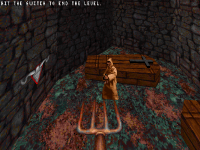
As a kickoff-person shooter, Claret is played through the perspective of the player-controlled character. Like Doom and Knuckles Nukem 3D, the player must navigate through the maze-like levels of each episode (set of levels), seeking keys or activating switches to enable progress, looking for the goal that ends the level. The role player does this for several levels until the "boss" level is reached and the histrion must defeat a large opponent to end the episode. While the player travels through the level, he/she must avoid or destroy the different enemies that attempt to kill the histrion.
Blood is organized in four episodes, with each episode containing a total of 8-ix different maps which consist of vi-seven regular levels, one "dominate" level, and ane undercover level. Level design is varied, equally some locations seem to lead into each other, but others jump out at the player. Some locations draw inspiration from cities in the era, with such locations as ceremonious buildings, museums, pubs, and shopping centres. Others are generic temples or mines.
Many levels are centered effectually a particular location, similar a mortuary, a train station, a carnival, a sewer, a hospital or a lumber manufactory, and each is designed to include elements typical of these places (e.g. a crematorium in the mortuary, attractions at the carnival). These oft have a Victorian or Edwardian architectural way, especially seen in the "haunted house" levels. Other areas are meant to resemble maze-like temples or generic catacombs, and some are completely original, such as "E4M7: In The Mankind", which resembles the inside of a body, with walls which drain when shot.
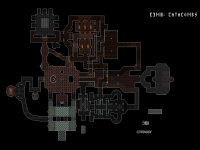
Blood was noted for its challenging, but realistic level blueprint, likewise every bit the affluence of enemies and weapons. Modern 3-D, fully-textured models require more computing power load, so the sprite-based game play of Blood allowed large numbers of enemies and objects on the screen at once. Also, due to the limited artificial intelligence on display, hostiles had to appear in big numbers to pose a significant claiming to the actor.
The player's progress is farther complicated by unlike types of traps, including burdensome blocks, explosive barrels, lava pits, precarious cliff-sides, jumping puzzles, and combination lock doors. Blood was also 1 of the offset first person shooter games (along with Marathon, Strife, System Shock and Dark Forces) to characteristic alternate firing modes for each weapon. Most guns in Claret accept ii completely unlike methods of dealing damage, compared to earlier games in which each weapon had only a single type of firing mode.
The teleporter, a common trope in first person shooter games like Quake, is rarely used in Claret, which has a less loftier-tech motif and adds to the realism and super natural feel. Blood likewise contained secrets - areas that are difficult to access or discover and often contain bonuses, merely added the new concept of "Super Secrets" - areas that are nearly impossible to observe or reach, just which merit large rewards, such as assuasive the histrion access to a Napalm Launcher in the very first level.
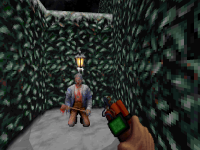
Graphic violence is one of the central features of Claret. Enemies can be blown to pieces, with streams of blood and chunks of flesh raining downward. Zombie heads can be shot off and and so kicked around like soccer balls, spewing fountains of blood from the neck. If enemies are ready on burn, they burst into flames and run around flailing their limbs. Innocents (non-combatants) announced in several levels and tin can exist killed without attrition. Each of these instances comes accompanied with screams of terror and hurting, making audio an integral office of the tearing atmosphere. The levels are designed in the aforementioned spirit, with locations such equally torture chambers, funeral homes, scientific laboratories, and hellish temples. Each location features walls splattered with blood, dismembered corpses, bodies in metal drums, and other grotesque situations.
In addition, Blood contains a large number of cultural references, particularly to horror movies and slasher films. Many elements are deliberately anachronistic, including weapons, pop civilisation, and other details. In item, "E2M4: The Disregarded Hotel", "E4M4: Crystal Lake", and "E4M9: Mall of the Dead" are whole levels based on the movies The Shining, Friday the 13th, and Dawn of the Dead respectively. For a consummate list, come across "References in Blood".
Multiplayer [edit]
Come across also: BloodBath Guide
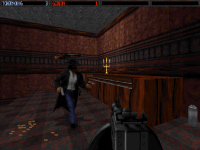
Blood is principally a single role player game, simply features the ability to battle other players across a figurer connexion. The two game modes are cooperative, which allows ii players to play through a unmarried thespian game, and Deathmatch (known in the game as BloodBath). The goal of this mode is to kill the other players earlier the player himself is killed. Gameplay takes place on an especially designed level with power-upwards & weapon caches and strategic areas, or a single-player level. To finish the level or match, a time limit or 'frag limit' had to be reached.
One of the unique features of BloodBath was "The Voice", an audio commentator who appear an irreverent or trite phrase on each frag, humiliating the player. This added to the encarmine way and competitive nature of the game, and punctuates the death of other opponents. "The Vox" is credited to Jason Hall, who was CEO of Monolith Productions at the time of the Blood development. It should exist noted that The Vocalization is indistinguishable from Tchernobog's voice.
Another feature was "Humiliation". If the actor had his or her health drained to exactly nix, he or she would be rendered immobile, but not dead. To an outside observer, the player would be kneeling. This would allow anyone to complete a humiliating death, such every bit jumping on the caput, or death by Pitchfork. The victim, however, had a chance to resurrect him/herself by repeatedly pressing the space bar, like to how one removes Choking Hands in the single-player game.
Like well-nigh games in this era, net play was not well established. Therefore options for connecting to other computers relied upon the standard modem, LAN (IPX protocol), or series cable connections. Modem and serial cablevision connections only allowed two histrion games, while an IPX network connectedness could back up up to eight players. Online multiplayer was available at launch using X, DWANGO and other third party tools (RTIME, MPATH/MPLAYER, Oestrus, ect.) Nigh of these third political party services are no longer available, but modern internet play is possible using alternate solutions such equally Meltdown. Due to the game'south netcode being outdated, lag and latency issues may occur.
Applied science [edit]

Primary article: Build
Blood is powered by the Build engine created by Ken Silverman, the previous author of Ken'due south Labyrinth published by Epic MegaGames, under the direction of 3D Realms. The Build engine renders its world on a two-dimensional grid using airtight 2D shapes called "sectors" and simple flat objects chosen "sprites" to populate the globe geometry with objects. It is generally considered to be a ii.5D engine, since the bones earth geometry is two-dimensional with an added height component, every bit each sector may take a unlike ceiling and floor summit, and the ceiling and flooring may be angled forth 1 line of the sector. However the final result is that the earth looks three-dimensional due to the style the engine renders information technology.
The version of the Build engine used in Blood makes use of voxels for smaller object like weapons, ammo, power-ups, and decorations, such as the tombstones in the first level of "E1M1: Cradle to Grave". Like many other games of the period Blood too shipped with a number of Build engine tools on the retail disk including MAPEDIT and ARTEDIT, which helped encourage the creation of fan made modifications and custom level sets.
This technological heritage has placed Blood as existence one of the "Big Four" Build engine games alongside Duke Nukem 3D, Shadow Warrior, and Redneck Rampage, although the latter is sometimes dropped leaving it equally just being the "Big Three", with Claret always existence included. Ion Fury, released in 2019, is intended every bit a new entry into the collection, building upon the onetime games' legacy.
Story [edit]
"Yous're office of a cabal. A cult. Merely you lot've been thrown down by the person yous worshipped and worked for ... You're not just expert versus evil. You're evil trying to fight a bigger evil. There'south no specific time frame. The setting combines the futuristic with a different, supernatural industrial revolution. It too has voodoo in it."--Designer Nick Newhard - June 1997
Blood takes identify in 1928. The game documentation does not specify an exact twelvemonth; the developers described the game as not having a set time period and anachronistic elements abound, but the game's sequel Blood Two: The Called takes place in 2028 and states that it has been one hundred years since the events in Claret. Although the backstory was not delineated within the game itself, the Monolith website, the Claret manual, and an accompanying text file presented the few facts known about the precursory events, such as Caleb'south human relationship with Ophelia.
The game'southward hero (or anti-hero) is a homo named Caleb (voiced past Stephan Weyte), a merciless gunfighter born in Texas who serves a cult chosen "The Conduce" that worships the dark god Tchernobog (voiced by Monolith CEO Jason Hall, who was credited simply as "The Vocalisation"). Caleb joined the cult later on meeting Ophelia Price, a woman whose homestead was burned downwardly by the Cabal, killing her husband and baby son. She blamed her spouse for their deaths, because he wanted to rescind his membership. One-half-crazy and rambling, Caleb nursed her back to health. Information technology is implied that she later became Caleb'south lover, and introduced him to the cult. Together they rose to the highest ranks and became "The Chosen", the four nearly esteemed generals of Tchernobog's army (the other two being Ishmael and Gabriel).
Caleb is a sarcastic human being with a strong aptitude towards sadism, taking pleasure in killing about anything, whether information technology impedes his quest or not. He has a prominent sense of sense of humor, frequently making quips while taking the lives of others, or commenting cynically on surrounding events. Though when he comes to The Hall of the Epiphany at the end of the game, he takes a more serious, determined tone.
Episodes [edit]
The story starts in The Hall of the Epiphany, where Tchernobog sits on his throne, chanting occurring in the groundwork. The four Chosen stand before him.
TCHERNOBOG: Welcome, my servants... my slaves.
A robed cultist shuffles into the room (some remember he may be the Cabal leader, as Tchernobog seems to speak through him). He pulls dorsum his hood, revealing a confront devoid of eyes, sharp teeth, and an ugly, gnarled face.
CALEB: What is thy bidding, my main?
The cultist stretches up, every bit if by an unknown force. His eyes glow white, his jaw drops, and he grunts and groans, every bit if choking.
TCHERNOBOG: Yous have failed me. I disavow you lot all.
The other Chosen react incredulously.
CALEB: What the?
OPHELIA: What?
The cultist smiles sadistically, right before his flesh rapidly decomposes and melts off his skeleton. Caleb looks right and sees Shial descend upon Gabriel and carry him up into the darkness. To his left, Ishmael has flare-up into flames and collapses equally Cerberus and two Hell Hounds arroyo.
OPHELIA: What's happening?
Ophelia looks around, also stunned to move. Cheogh flies in from behind and grabs her. Caleb jumps for her, only it is too late, and all he tin practice is watch Cheogh'south glowing white eyes fade into the blackness.
TCHERNOBOG: I take taken your love. Now I volition take your life.
Caleb looks effectually as darkness descends upon him. He begins falling into the void.
TCHERNOBOG: Consider my power... in a hollow grave.
Episode ane: The Way of All Flesh [edit]
Caleb rises from his grave in a tomb located in a graveyard of the "Morningside Mortuary" funeral abode with the words: "I alive... once again" (E1M1: Cradle to Grave). He begins by searching for his love Ophelia, taken by the gargoyle Cheogh. Unfortunately, Tchernobog'south followers are everywhere. Caleb moves to the train station behind the cemetery (E1M2: Incorrect Side of the Tracks) and boards the "Phantom Express" (E1M3: Phantom Limited). He kills all the Cabal on the railroad train and releases the safety locks on the boiler, exploding the engine and derails the train. He emerges from the wreckage and finds he has arrived at a carnival (E1M4: Dark Carnival) with several Cabal-controlled attractions. Caleb finds a cleaved span and a pond. If he crosses the span, he finds a side path to a new ride under construction (E1M8: Business firm of Horrors). Either mode, an underwater cavern leads him to one of the Conduce strongholds, a deconsecrated cathedral, where the droning dirge in the Cabal's language echoes throughout the grounds (E1M5: Hallowed Grounds). Cutting through swarms of Cabal loyalists and other creatures, Caleb gains entrance to The Great Temple (E1M6: The Bully Temple), a place protected by numerous underwater tunnels, traps, and Conduce minions. Caleb finds a teleporter that leads him to a rotunda, which leads to Cheogh's temple (E1M7: Altar of Rock). Caleb finds Ophelia at the top of the altar, crucified on a slab. He screams in anguish, when the temple begins to rumble, and a wall collapses. Cheogh emerges and Caleb slays him. He takes Ophelia down and places her on a funeral pyre to cremate her trunk. Afterward, he approaches the body of Cheogh, points his shotgun at the animal's head, and pulls the trigger.
Episode ii: Even Death May Die [edit]
Finished with Cheogh, Caleb travels to the arctic to look for Shial who has taken Gabriel. He starts on a small rowboat and runs into a large, wooden sailing ship partially frozen in an iceberg (E2M1: Shipwrecked). Unfortunately, the Cabal are swarming all over it, only Caleb uses the ship to open up a path through the ice to a lumber mill (E2M2: The Lumber Manufactory) that the Cabal has transformed into a crude human remains processing factory. He so gain to a snowfall-covered maze of hedges (E2M3: Rest for the Wicked) leading to the Overlooked Hotel (E2M4: The Overlooked Hotel). Within the hotel are a set of tomes, which Caleb can apply to open the door to a mountainous area filled with Cabal loyalists (E2M9: Thin Water ice). He then moves to a two-story haunted mansion (E2M5: The Haunting) with a kitchen, gardens, a library, a cellar, and even an indoor pool. It is the pool that hides the passage to an abandoned mining facility (E2M6: The Cold Rush). Caleb navigates the mine and delves deeper into the treacherous tunnels (E2M7: Bowels of the Earth) until he arrives at the lair of Shial (E2M8: The Lair of Shial), deep under the World'south surface. Inside a pocket-sized stony cavern, he finds Gabriel wrapped in a cocoon, along with the mother spider herself. Caleb kills her and her children, destroying her body with a well-placed boot stomp. He walks up to Gabriel, pulls his middle out of the cocoon, and drinks its claret in gild to proceeds ability.
Episode 3: A Cheerio to Arms [edit]
With two of Tchernobog's lieutenants killed, Caleb has one left - Cerberus - the beast responsible for the death of Ishmael. Caleb travels to a small boondocks in French republic (E3M1: Ghost Boondocks) and occupies a small tenement. Few still live in the identify, aside from the Cabal and its minions. No sooner does Caleb go far (E3M2: The Siege) then he finds himself in the midst of airborne carpet bombings. This may be the result of Cabal, capitalizing on the state of war-torn city after the First World State of war. Finding access keys in the bank, a meat processing constitute, and city hall, Caleb finds access to the sewers to reach the other side of the metropolis (E3M3: Raw Sewage). He emerges in front end of a infirmary seized by the Cabal (E3M4: The Sick Ward). The interior contains patient rooms, a morgue, and an "assisted" suicide room. If Caleb finds a secret access in the chapel, he can travel through the catacombs (E3M8: Catacombs). One time out of either the hospital or the catacombs, Caleb moves into a blast furnace (E3M5: Spare Parts). Caleb navigates through the factory, which is another place the Cabal had transformed for the purpose of performing living sacrifices. Afterwards leaving the furnance, Caleb enters a dam command installation (E3M6: Monster Bait) located close to Cerberus' cavern. Caleb overrides the dam controls and blows it up. The resulting flooding reveals the way to a lava-filled crenel nether the World (E3M7: The Pit of Cerberus). Once in Cerberus' lair, Hell Hounds guard several seals which Caleb breaks, allowing admission to Cerberus' inner sanctum. The two-headed beast attacks, but proves to be no friction match for Caleb. Afterwards the beast dies, he fills its tummy with Remote Detonators and blows it upwards raining him in blood. Caleb says to Cerberus: "Residuum in Pieces", for the murder of his friend Ishmael.
Episode 4: Dead Reckoning [edit]
With the Chosen avenged, Caleb heads for the The Hall of the Epiphany, where the dark god is waiting. The first step is to cantankerous a strange country, through a night laboratory (E4M1: Butchery Loves Company), peradventure run past the Cabal, and dive into an aquatic breeding facility filled with Gill Beasts (E4M2: Breeding Grounds). Traveling through the pipes, Caleb bursts out of a water cistern, and travels through a charnel business firm (E4M3: Charnel House) serving equally a disposal site for dead creatures. Nearby at that place is a passage to a forest-rimmed lake with woods cabins (E4M4: Crystal Lake). The exit is reached through a toilet to a blocked off rock cavern. Here at that place are 2 paths Caleb can take. The less obvious way leads to a shopping mall where zombies and other Cabal have taken over (E4M9: Mall of the Expressionless). The other way leads to a lava filled cave (E4M5: Fire and Brimstone), equally Caleb approaches the territory that houses the seat of his former master. Caleb makes his way through the hellish cave and ascends to a mountain where a Conduce temple sits above the clouds (E4M6: The Ganglion Depths), guarded by some of the toughest creatures the Cabal has to offer. Caleb fights his way through the temple, until he uncovers an entryway made of stitched-together flesh that bleeds when hit (E4M7: In The Mankind). Caleb moves through the area, passing through the tummy and intestines to reach the center, the final expanse leading to Tchernobog's throne (E4M8: The Hall of the Epiphany). There, Caleb stands at the steps to The Hall of the Epiphany and calls to his master, asking him why they were cast down. Tchernobog reveals that he condemned them because he knew that Caleb would return, with every life he had taken making him stronger. Tchernobog wanted to use Caleb'south sacrifice to finally open the doors betwixt dimensions and inherit the Earth. Caleb ascends the steps and defeats reincarnations of Cheogh, Shial and Cerberus before reaching the dark god himself. As Caleb activates the concluding colonnade, Tchernobog'southward voice echoes, "I Take AWAITED You lot. KNEEL BEFORE ME", to which Caleb replies "I'm gonna have to put you down!"
Epilogue [edit]
After a tearing battle, Caleb destroys the nighttime god and His body disappears in a wink of blueish and white light. A man approaches, praising Caleb and spouting the Lord'southward prayer. Nonchalantly, Caleb blasts him in the breast with a Tommy Gun and leaves the Hall.
Multiplayer Maps [edit]
These are the multiplayer maps (Bloodbath) that were included with the retail version of Blood. Expansion packs added other maps.
- BB1: The Stronghold
- BB2: Winter Wonderland
- BB3: Bodies
- BB4: The Belfry
- BB5: Click!
- BB6: Twin Fortress
- BB7: Midgard
- BB8: Fun With Heads
These are listed as episode 5 within the game'southward INI file. Despite this, Cryptic Passage is ordinarily regarded as a fifth episode equally well, despite beingness listed every bit episode 1 within its own INI file and having its own second episode of BloodBath maps. The new single actor episode from the Plasma Pak follows on from either as episode vi within the main Blood INI.
Expansion Packs [edit]
 | Ambiguous Passage - This expansion pack was released in 1997, and was developed by Sunstorm Interactive, a video game development company known for value-priced game modifications. Since information technology was not created past the original creators, there were no modifications to the existing gameplay, but the inclusion of a new unmarried-actor episode. Notwithstanding, the single-histrion included larger maps and a small storyline of Caleb hunting downward a stolen curl that was rightfully his. |
 | Plasma Pak - This expansion pack was released in 1997, and was developed by Monolith Productions. It contains several modifications, including new enemies, new weapons modes, new BloodBath maps, and a new single-player episode. In that location is no explicitly stated storyline, but from various clues, Caleb is hunting down a group of Cabal being trained to become the new Called. Information technology besides includes several bug fixes. |
Level Packs [edit]
At that place were two commercial level pack compilations released for Blood in the fashion of WizardWorks Software's D!Zone for Doom. Neither of these level packs announced to have e'er been sanctioned by Monolith Productions. Online only compilations of custom levels have also subsequently been amassed by fans, as discussed in the post-obit section.
Fan Add-Ons [edit]
Main article: Listing of Mods for Claret

Death Wish is frequently held up as a standard bearer for custom content
Due to the high fan demand for more Blood content, especially afterward Monolith stopped working on the serial in 1999, many improver projects have sprung up. The goal of most of these has been to replicate or expand on the original Blood experience. This started on sites like Game Leader, and has since been kept going by repositories such every bit RTCM, blood.freeminded.de and The Bloody Repo, in addition to general purpose hosts such as ModDB and GameFront.
Interestingly, the amount of quality, completed Blood fan add together-ons increased dramatically around and afterwards the game's tenth anniversary, with efforts such as The Carnage Continues (2006), Rage Against the Machine (2007), Bloody Pulp Fiction (2009) and Expiry Wish (2011) reaching farther than before attempted large scale projects such equally The 13th Realm (1998), Blood Slaughter Files (1998), Crudox Cruo: Fresh BLOOD! (1998), and Tiny Town (1999) from the game'southward younger days.
A common joke used to be that Blood add-on projects were cursed to exist incomplete, most notably with BloodLines (2002) which ultimately released unfinished though still fairly elaborate. Some early on projects that did attain completion were the less aggressive Banzai's Improver (1998), Fourth dimension Episode (1999), and Killing Time (1999), equally well as the classic three level improver releases Middle of the Blood (1997), Journey to Hell (1998), Gods (1998), and Ravenloft (1998).
At least one attempt, Dwayne Anderson's Legends of the Iconoclast, has managed to span both eras, with an initial release from 2001 to 2004 followed past a remake project started ten years after in April 2011 with releases in 2012 and 2017. Dustin "Bloatoid" Twilley'due south career has also stretched over many years, with early efforts such as Inherit the Globe (1999) and Hostile Takeover (2001) culminating a decade afterward with Death Wish in 2011, which then featured another six years of polish for version 1.4 in 2017 and farther. This maturation is part of the reason why Death Wish is often held up as the gold standard for Claret add-ons.
Betwixt these 2 periods in the mid-2000s, a large chunk of the new releases came from the Russian Blood Community and related fan-base, such equally The Outpost Mortem (2005), The Sect War (2005), Sectant (2006), and Quondam Friend (2007).
Subsequent major original releases have included French Meat and French Meat 2 (2012, 2019) as well as Caleb Volition Have His Revenge on Toronto (2013-nowadays), with new campaigns still in evolution. The comparative lull in new episodes in the subsequently 2010s was broken with Out for Blood, The Style of Ira, Fleshed Out, Trauma Therapy and 500 Milliliters of /vr/ since the latter half of 2019.
Individual mappers such as Martin and Jason Brentnall, David Wikström, Austin Adams and Vili Nyström have also developed notable portfolios. Meanwhile, the Alone in the Nighttime series of mods has focused on expanding the technical telescopic of the game, establishing efforts such as a custom Voxel Pack and the Weapons Modern, amidst others. Curator BME put out a complete collection of Claret maps called BME'due south Claret Map Pack each year from 2013 to 2019, post-obit from his re-scripted releases of many classic add-ons. More selective sets such as The Best of Blood.Freeminded.De (2011) and the Blood Chronicles (2004, 2014) volumes have also been compiled.
Since 2017, these fan campaigns can at present be played exterior the original DOS executable via BloodGDX, leading to an increased interest shown through Let's Play and video walkthrough series on YouTube (about notably by Pagb666). The later on released NBlood source port (and fork included within Raze) can also load custom maps, with a new subsystem being utilized by No Hope in Sight and Eviction.
Fan content also largely retains compatibility with the official remaster of the game developed by Night Swoop Studios called Blood: Fresh Supply, which as well offers new modding potential due to its underlying Kex Engine, such as having a functional scripting system (currently being pushed by the Extra Crispy mod, too as Arcade Mode). This excitement has lead to revived or updated versions to exist worked on for Expiry Wish, Bloody Lurid Fiction and the once cursed Bloodlines, too as overhaul mods such as the Claret Upscale Pack and the Blood Voxel Pack.
Development [edit]
Master article: Evolution of Blood
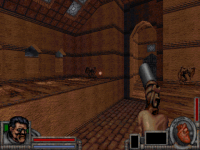
Development screamshot featuring Michael and an early HUD
QStudios, with the supervision of Apogee Software, started development of Claret nether the championship "Horror 3D" in early 1994. This was in parallel with several other projects on the Build engine, namely Duke Nukem 3D, Shadow Warrior 3D and Ruins: Return of the Gods. At this bespeak in time the QStudios "office" was the family room of designer Nick Newhard'southward house. Subsequently the successful release of Knuckles Nukem 3D, development progress was fabricated public starting in June 1996 with weekly updates on first the 3D Realms and then later the official Blood websites.
QStudios was merged into Monolith Productions and its offices in July 1996. Growing conflicts with 3D Realms over the development direction of the Build engine under Ken Silverman as well various personal and professional disagreements over staffing and contract bug led to the publisher existence changed to GT Interactive starting in November 1996 with Rick Raymo as producer. 3D Realms instead focused on completing Shadow Warrior.
Former during the game's development there was a leak onto the Internet of the Blood source code by an employee at a figurer repair shop, dated Feb 17, 1996, which was reacted to severely past the game'due south publisher. Eventually Monolith settled the case in court, but the released files became known to the customs as the Blood Blastoff. This beta demo contains several differences from the released game, including Caleb as a robed fanatic named Michael; his character was later greatly expanded past his actor Stephan Weyte. The shareware version also contained several differences, such as delirium mushrooms and a different theme.
The shareware version of Blood was released on March vii, 1997 following the game entering the beta stage on January 2d. The game went gold on April 25th and was first released in Due north American retail stores on May 31, 1997 by GT Interactive, with the game coming to Europe on June 30, 1997 published by Eidos.
Modernization Efforts [edit]
Run into too: Listing of Source Ports and Recreations
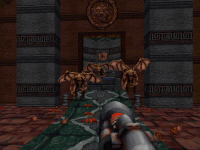
BloodCM is currently the most authentic Claret recreation
Despite the best efforts of fans, most notably the Blood Source Campaign, the source lawmaking to Claret has never been released. This has pb to projects like Transfusion, ZBlood, BloodCM, and others which try to recreate the game or game's style on more open and flexible alternative engines.
The Build engine code has been released, as has the code to the similar games Duke Nukem 3D and Shadow Warrior. Based on this, a few source port projects have been attempted, which vary from recreation projects by reading the original game's assets rather than but adapting or recreating them; something much less ambiguous legally.
The outset source port to have a stable public release was BloodGDX, partly created via referencing the leaked full Blood Alpha source code. Both BloodCM and BloodGDX were developed by Alexander "M210" Makarov, transitioning from one to the other. GDX was later joined by NBlood, a solution based on the EDuke32 engine past Alexey "Nuke.YKT" Khokholov. The fact that both of these were by Russian coders has lead them to sometimes be referred to every bit the "Slav Ports". NBlood was subsequently forked equally part of the Raze projection.
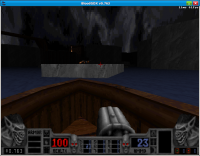
BloodGDX was the first stable released source port
A major inhibitor for such projects has been that Blood does non shop its game logic externally by having whatsoever sort of scripting ability, the manner Duke Nukem 3D does with CON files, making its functions fairly opaque and thus harder to contrary engineer. True modding of Blood game logic was idea impossible until recently with QAV file editing such as with the Weapons Mod. The game does not even support the power to use external content (as Duke had with GRP files, Doom had with WADs, and Claret Two featured with REZ files) likewise maps or episode INI files, and so all modifications that utilise new multimedia are done via overwriting, at least temporarily, existing base assets. According to Nick Newhard, this lack of flexibility was even a concern during the game's development.
In August 2012, Jason Hall pitched a mod upgraded version of Claret for current systems and consoles, but was unable to generate significant enough interest from Atari in club to movement frontward. Others also expressed an interest in such a project over the next few years, including Devolver Digital who published updated versions of Knuckles Nukem 3D and Shadow Warrior, Interceptor Entertainment who purchased 3D Realms, and Night Dive Studios, who specialize in reviving older games.
On Dec 7, 2018 it was announced that Atari had granted Nighttime Dive Studios a license to produce a proclaimed "remastered version" of the original Blood refitted onto the Kex Engine. This was released on May ix, 2019 every bit Blood: Fresh Supply. In improver to working on gimmicky systems and using modern frameworks, information technology as well features avant-garde features such equally an internal scripting system, online and split-screen multiplayer, new graphical effects, a customizable difficulty mode and a new mouse-aiming and controller interface. Divergences from the original, a troubled patching process, and still limited cantankerous-platform compatibility accept provoked controversy withal.
Release and Critical Reception [edit]
"With the overwhelming success of the Knuckles Nukem 3D shareware release and anticipation already edifice for 3D Realms' upcoming Shadow Warrior, nosotros have some understandably high expectations to live upward to. At this point, we are confident that Blood will surpass those expectations by leaps and premises, but every bit it has already surpassed our ain."--Blood Website
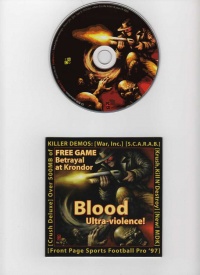
An example of a packaged version of the Blood shareware from the time of its original release
Blood received a metascore of 83 from MobyGames, holds and a score of 82 on Metacritic. Its highest rating (100) was given past The Adrenaline Vault (the first to receive a five star rating; later matched past Shogo), an stance shared by 3D Action Gamers and PC Gaming, while its lowest (60) came from Computer Games Magazine. The game held a score of four and half stars on GOG.com prior to it being merged with Fresh Supply, featuring highly complimentary user reviews.
Blood soon grew into a cult classic, especially amid fans of other Build engine titles. Afterward its release Monolith Productions put a selection of gimmicky reviews of the game up on the Blood website, virtually of which are now merely bachelor through the Wayback Machine.
Due to its graphic violence, Blood was placed on the BPjM listing of restricted games in Germany. A period editorial for the Los Angeles Times derided both Claret and Redneck Rampage, stating that "merely when yous idea bloody shoot-'em-up games had gone also far in adolescent humor and senseless gore, these titles go even further." An article on Salon commented upon the infamous "bathtub of blood" advertisement for Blood in relation to the video game controversy following the Columbine shooting.
Visitor executive Jason Hall responded to contemporary criticism of the game on Usenet in this Bulletin board system post, almost of which concerned its employ of the then out-dated Build engine when compared to the likes of Quake and a perceived over similarity to its swain Build engine stable-mate Duke Nukem 3D. This was also occasionally raised every bit a benefit, with Blood being argued equally the height of the established 2.5D commencement-person shooter pantheon. Several reviewers also praised Claret for its unique setting and gothic elements, differentiating information technology from the dominate scientific discipline fiction trappings seen in Doom and Duke Nukem 3D. Some drew comparisons instead to the dark fantasy of Heretic and Hexen, although withal noting its furthering of the interactivity exhibited in 3D Realms games.
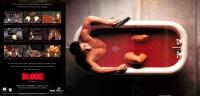
The infamous bathtub advertisement for Blood that appeared in magazines post-obit the game's release in 1997
Both gimmicky and mod reviews have noted the game'due south sometimes brutal difficulty, as did level designer James Wilson Iii himself, earning it both praise and criticism. Some have fifty-fifty observed that the game possesses an inverted difficulty curve, with the first episode beingness the hardest due to its lack of the more dissentious weapons and stronger items. Later skill levels, most notably Extra Crispy, were said to have been balanced with cooperative play in heed.
Artistic director Nick Newhard has expressed regret over how much content was bachelor in the game's shareware release, believing that information technology satiated players at the expense of encouraging them to seek out and purchase the full retail version. He has also remarked that the Life Leech weapon and the high hit-scan accurateness of the Tommy Gun wielding Fanatics negatively affected the game'southward balance.
GamingOnLinux reviewer Hamish Paul Wilson decided in a 2015 retrospective that Blood was easily the best of the iii major Build engine games, stating that Claret was "i of the most underrated shooters of the whole decade. Claret arguably built more on the legacy of Duke Nukem 3D than Shadow Warrior did, taking its gameplay to sophisticated new heights and offering its referential overtones with an even greater degree of refinement." In a 2017 video review of ZBlood prominent YouTuber Gmanlives agreed, commenting that out of the major Build engine games Blood always "edged itself out as [his] favourite of the three".
Player Attack described Blood in a 2011 article equally "the best of the Build engine games after Knuckles Nukem 3D, with its combination of scary atmosphere, nifty level pattern and challenging gameplay putting it above the rest." Screen Rant concluded in a 2019 article that while "it was i of many Doom clones in the vein of Wolfenstein and Duke Nukem, and while not a lot of people played it, it is now regarded every bit one of the best FPS games of its time."
Blood is indexed in the Encyclopedia of Weird Westerns: Supernatural and Science Fiction Elements in Novels, Pulps, Comics, Films, Goggle box and Games by Paul Green. The manwha Priest is said to be "inseparably related" to Blood in terms of inspiration, and was adapted into a motion flick; both notably feature battles with the undead like to the fan favourite E1M3: Phantom Express level. The upcoming "boomer shooter" Cultic, being published by 3D Realms, exudes an obvious influence from Blood.
See Also [edit]
- Bugs in Blood: a listing of known bugs in Claret.
- Blood Screamshot Gallery: a gallery of Blood screamshots.
- Cutscene Image Gallery: a gallery of cut scene shots, including those from Blood.
External Links [edit]
- Blood's Official Website
- Official Blood Atari Page
- One-time GT Interactive Page
- Official Blood page from TEN
- Blood on Wikipedia
- Quondam Claret Evolution Website (Weekly Updates from June 1996 - December 1996)
- Blood Development Weekly Updates from Baronial 1996 - May 1997
- Blood at FirstPersonShooters.cyberspace
- Blood series on Idiot box Tropes
- Blood at the Videogame Music Preservation Foundation Wiki
- Blood DOSBox Screenshots
- Claret Let's Play Archive
Articles [edit]
- GT Interactive and Monolith's 'Blood' shareware spilling all over the Cyberspace, Business Wire, April eight, 1997 (fractional annal).
- PC Zone preview scans
- Game Center's preview of Blood
- Gamesmania Sneak Peaks - Claret
- Blood preview - CD Magazine
- Claret preview from Game Piece (February 1997)
- Blood vs. Shadow Warrior: The True Boxing Begins! - The Adrenaline Vault
- Game Center - Shareware Gilded: Blood (April fourteen, 1997)
- "What was your favourite chapter from the original Blood, and why?" - Planet Blood Mailbag (March seven, 2000)
- Retro Review Grudge Match: Duke Nukem 3D vs Blood - NAG (September 14, 2010)
- The Forgotten First-Person Shooters You lot Need to Play - 1UP.com (October 2010)
- x great PC games that need a improvement - Big Download (January 13, 2009)
- The Big Three Build Engine Games on GOG - GamingOnLinux (June 23, 2015)
- Underdogs: six forgotten classics from PC gaming history - Geek Squad (July fourteen, 2015)
- The Top 25 Horror Games Of All Time - Game Informer (October 31, 2015) (Mirror)
- Going in with a bang – the all-time debuts in the history of gaming - GAMEPRESSURE.COM (November 25, 2015)
- The 25 Best Horror Games on PC (Blood at 25) - Rock, Newspaper, Shotgun (May 12, 2017)
- 10 Horror Games That are Perfect to Play on Halloween! - Encarmine Icky (October 31, 2018)
- How do two companies own the rights to Claret? - Polgyon (December 12, 2018)
Reviews [edit]
Gimmicky (1997-2000)
- Shareware review from The Adrenaline Vault (1997)
- Review from The Adrenaline Vault (April 24, 1997)
- Shareware review by Games Domain (March 1997)
- Review by GamePro (May 31, 1997)
- Review by Games Domain (June 1997)
- Review past PCM&E (June ii, 1997)
- Review by 3D Gamers (June 12, 1997)
- Review from GameSpot (June 26, 1997)
- Shareware review by PC Gaming (1997)
- Review by PC Gaming (1997)
- Review by Sharepaper (1997)
- Review by Game Demo (1997)
- Review from Game Power (1997)
- Review from Games Mania (1997)
- Game of the Calendar month - Blood Review
- Review by Game Pen (1997)
- Review by Planet Convulse (1997)
- Review scans - PC Gamer
- Review scans - PC PowerPlay (Australia)
- Review by Gamezilla (Oct 13, 1999)
- Review by Hot Games
Retrospective (2000-nowadays)
- Blood Review - Just Games Retro (July 22, 2006)
- The 28 Best Ever Start Person Shooter Games - PC Adviser (Blood at 27; October 18, 2008)
- Review from Retro Gamer (October 27, 2008)
- Review from A Force for Good (July 14, 2010)
- Review from Thunderbolt (September 25, 2010)
- GOG Box: Blood - GameFront (March 23, 2012)
- Yous Should Accept Played This: Blood - The Married Gamers (February xix, 2013)
- Sat Crapshoot: Claret - PC Gamer (May 31, 2013)
- Review from Examiner.com (June 24, 2013)
- Have you Played that Game: Blood - G3AR (August 22, 2013)
- Review: Blood (One Unit Whole Claret Edition) - Retro Sensei (October 30, 2013)
- Review: Blood (One Unit Whole Blood Edition) - Old Game Hermit (October 30, 2013)
- Super Take a chance in Gaming - Blood (October 31, 2013)
- Lookback on Blood - Eden for Gaming (March 6, 2014)
- Heti retro bemutató: Claret (July 26, 2014) (Hungarian)
- Review from MyStudentStyle (August 20, 2014)
- Review from The Honest Gamers (October 28, 2014)
- Throwback Th: Blood - AusGamers (February 26, 2015)
- The Classic PC Games You Must Play - Blood - Kotaku (March 1, 2015)
- Classic Games Resurrected: Blood - HubPages (Apr 20, 2015)
- Blood Review - Game Nostalgia (May 29, 2015)
- Review from Hey Poor Actor (2015)
- 4-One Retro Corner: Blood (January iii, 2016)
- Hardcore Gaming 101: Blood (March 13, 2016)
- Bullet Points podcast - Episode 22: Blood (Baronial 15, 2016)
- Video Game Review: Claret - MovieFanCentral (November 2016)
- Blood: Nail from the Past Review - Previous Weapon (July 29, 2017)
- Hardcore Gaming 101 (Oct 16, 2017)
- Have You Played… Blood? - Rock, Newspaper, Shotgun (Oct 31, 2017)
- Review: Blood - A MOST Agreeable PASTTIME (June iv, 2017)
- Classic Video Games Review (1997) Blood : Occult and Horror Video Game - Stulman (2018)
- Review from Abode of the Underdogs
- Review from The Blood Theatre
- Review from Retro Garden
- Review from UAC Labs (Spanish)
Blogs
- Old schoolhouse review: Claret (February half dozen, 2008) (Translated)
- A First Person Shooter Worth Playing past Mattias Gustavsson (August 30, 2008)
- River City Retro: Claret... simply blood (May 1, 2010)
- Review from POWET.Telly (June four, 2010)
- Review from VGJUNK (Oct 20, 2010)
- Review from The Dukes Playground (February vii, 2012)
- Review from PolyPwn (August 14, 2012)
- Review from Erstwhile PC Gaming (May 11, 2013)
- Review from 8-bit Wizard (Oct 30, 2013)
- Blood | I want Jojo, I Desire JoJo, I WANT JOJO! (May 21, 2014)
- Review from Videogame Potpourri (February 12, 2014)
- Review from Muzzleland Press (December 11, 2014)
- Cult Review: Blood - The Video Game Library (February 19, 2015)
- Review from PekoeBlaze (May three, 2015)
- Blood: 20th Birthday & Retrospective - Heavy Metallic Otaku (May 31, 2017)
- Blood, The Perfect Game For This October - Autism-o-meter (October 1, 2020)
Source: https://blood-wiki.org/index.php/Blood

Post a Comment for "Blood One Whole Unit I Live Again"